
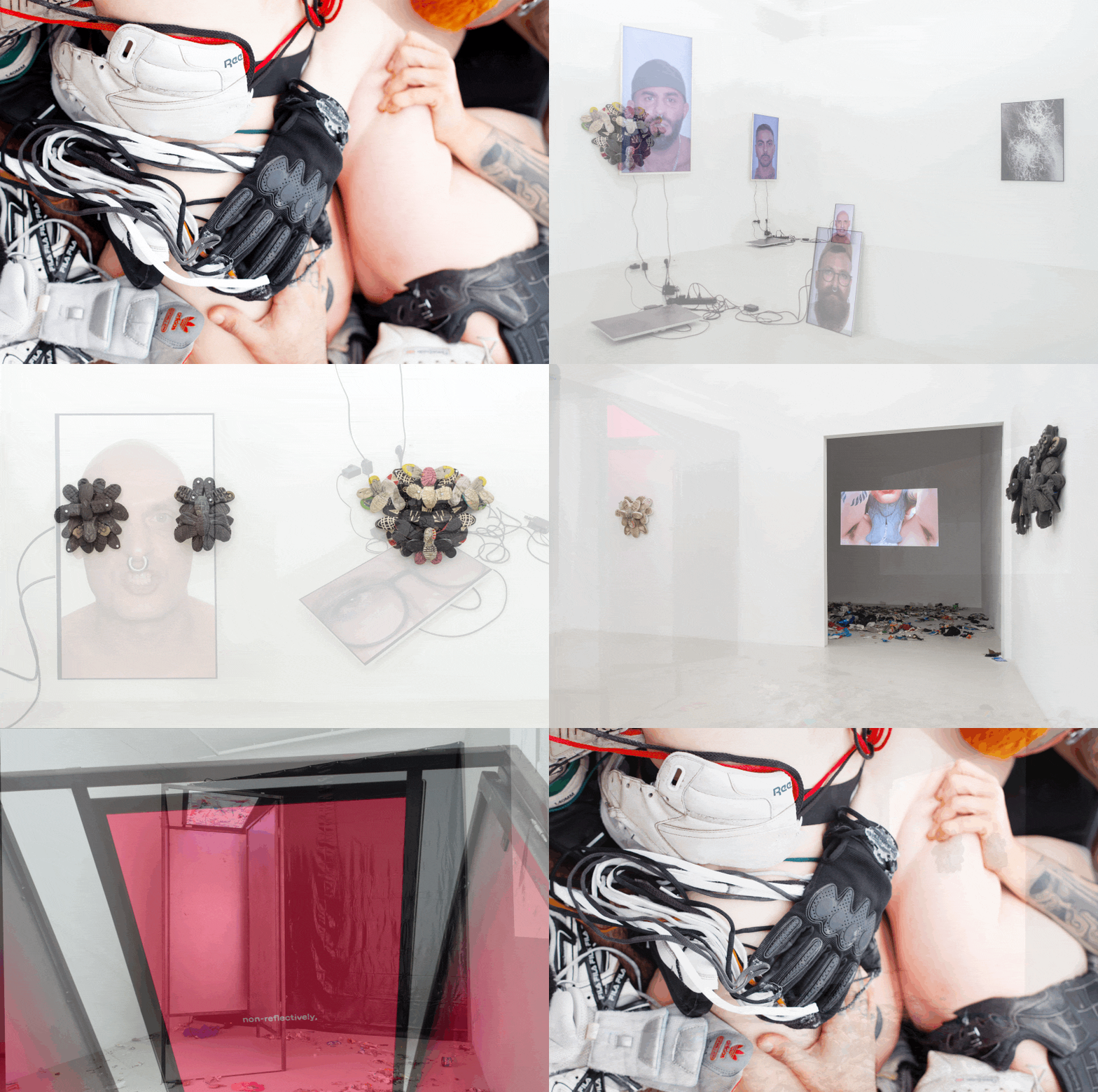
Mascha Naumann
Radical Tenderness
View complete PDF of the exhibition
4.9. – 10.10.26
About the exhibition
Radical Tenderness is Mascha Naumann’s first solo exhibition in Berlin since graduating from the Universität der Künste Berlin. The new mixed-media works emerged from collaborations with xan egger and their collective practice ( ) s-p-a-c-e, the photographer and artist Callum Leo Hughes and others from Berlin’s rave and subcultural scenes. They explore non-normative realities, club culture as a counter-public world of work, and questions of ownership, representation and trust.

Michael Schmidtmann
für jeden was dabei
Exhibition PDF download with text, list of works and exhibition views.
27.6. – 15.8.2026
About the exhibition
In für jeden was dabei, Michael Schmidtmann turns to the small carriers of everyday imagery: puzzle magazines, sketch pads, cigarette machines, receipt books, logos and packaging. Working from stock photos, he paints these already-designed objects by hand in meticulous detail in his studio in Düsseldorf-Bilk. Stripped of their function, they become pure surface – a quiet, humorous study of how design shapes daily life.

FORMAL KONZENTRAT
Linou Meyer, Stefan Pfeiffer, Solveig Schmid
Exhibition PDF with List of Works, exhibition views.
Duration: 16.5. – 20.6.2026
About the exhibition
FORMAL KONZENTRAT brings together three painters whose works centre on form itself. Rather than depicting, the paintings examine their own means: colour, surface, line and composition. Stefan Pfeiffer, a master student of Thomas Zipp at the Universität der Künste Berlin, shows works in which formal decisions become the actual subject. Solveig Schmid’s colour surfaces explore nuance, density and permeability in a direct painting process, as in walking in the rain (oil on cotton, 2026). Linou Meyer completes the trio with her own concentrated pictorial language.

Konrad Hanke
Fun without Suspicion
Duration: 11.4.-9.5.2026
View complete PDF of the exhibition
About the exhibition
In Fun without Suspicion, Konrad Hanke moves between visible form and elusive content. Fence slats, frame mouldings and manhole covers, cast in epoxy resin and painted matt grey, recall the neutral surfaces of 3D software. They are combined with digital collages built from historical maps of Thomas More’s Utopia, set against a magenta ground, the colour such programs use for missing textures.

Carola Ernst
Im Quantensprung
Duration: 21.2.-28.3.2026
View complete PDF of the exhibition
About the exhibition
Im Quantensprung, Carola Ernst’s ninth exhibition with the gallery, presents new works that reflect both current technological upheaval and a shift within her own practice. Close to mathematical and scientific ways of thinking, Ernst is known for her “psychogenic” paintings and drawings with an often holographic effect. Her new works concentrate on single media such as ink, watercolour, oil pastel, charcoal and graphite, each explored in its own group of works.

Hello, it´s we again
Hannah Cooke, Carola Ernst, Iris Helena Hamers, Konrad Hanke, Simon Hehemann, Manon Harrois,
Jonas Hofrichter, Vladimír Houdek, Laura Killer, Anna Ley, Martin Neumaier, Manfred Peckl, Hans Petri, Stefan Pfeiffer, Michael Schmidtmann, Lena Schramm, Nouchka Wolf, Heiko Wommelsdorf
Duration: 13.12.2025 – 7.2.2026
View complete PDF of the exhibition
About the exhibition
Hello, it’s we again brings together the gallery’s artists in one group exhibition: Hannah Cooke, Carola Ernst, Iris Helena Hamers, Konrad Hanke, Simon Hehemann, Manon Harrois, Jonas Hofrichter, Vladimír Houdek, Laura Killer, Anna Ley, Martin Neumaier, Manfred Peckl, Hans Petri, Stefan Pfeiffer, Peyman Rahimi, Michael Schmidtmann, Lena Schramm, Nouchka Wolf and Heiko Wommelsdorf.

Andrew Gilbert & Max Beckmann
Käthe Kollwitz feeds Andrew and Max Beckmann to her pet Giraffe
Duration : 13.10. – 6.12.2025
View complete PDF of the exhibition
About the exhibition
Andrew Gilbert places his own mixed-media works and drawings alongside prints by Max Beckmann, such as Frühling from the 1918 portfolio Gesichter. Under a title that casts Käthe Kollwitz as the protagonist, Käthe Kollwitz feeds Andrew and Max Beckmann to her pet Giraffe sets Gilbert’s ongoing critique of colonial history and violence in dialogue with German Expressionism.

Laura Killer
Feu la cendre
Duration: 6.9. – 4.10.2025
View complete PDF of the exhibition
About the exhibition
In Feu la cendre, her first solo exhibition with the gallery, Laura Killer (born 1992 in Krumbach) explores fire not only as a motif but as an active process. Scratching, writing, burning and sweeping leave direct traces in the material. Burnt matches and remnants of brooms and brushes, sealed in epoxy resin, appear as preserved relics. Taking its title from Jacques Derrida, the exhibition reflects on ash as an image of disappearance.

Iris Helena Hamers
Uligo
Duration: 12.7. – 23.8.2025
View complete PDF of the exhibition
About the exhibition
In Uligo, Iris Helena Hamers presents wall and hanging objects assembled from images found online, from memes and prompts as well as her own photographs. Rather than constructing meaning, she composes these motifs according to formal considerations – a contemporary form of collage in the age of Photoshop and AI-generated imagery. The publication includes a text by Ludwig Seyfarth.

Una Szeemann
Transcendental Seduction
Duration: 25.4. – 21.6.2025
View complete PDF of the exhibition
About the exhibition
At the centre of Una Szeemann’s exhibition Transcendental Seduction is the neon work of the same name, an angelic figure of circle, arrow and diamond that glows from its centre. The series Siren Spines combines black leather skins with gleaming metal structures, while the heliogravures Virare al tatto emerge from hand movements on a sand-covered glass plate – works between seduction, myth and the intangible.

Nouchka Wolf
Rast! Gast sein, nochmal.
Duration: 22.3. – 17.4.2025
View complete PDF of the exhibition
About the exhibition
In Rast! Gast sein, nochmal., Nouchka Wolf’s paintings do not depict paradise but barren, apocalyptic landscapes full of foreboding, inhabited by small, crooked, lost figures. Like the cherubim at the gates of Eden, the gaze in her works can only observe, not intervene. Works such as This will all be yours one Day (2025) show grotesque landscapes glowing in orange. The publication includes a text by Rosa Windt.

Simon Hehemann
windy room
Duration: 1.2. – 8.3.25
View complete PDF of the exhibition
About the exhibition
For windy room, Simon Hehemann built a room within the room from a system of perforated panels, in which a row of fans carries the wind into the gallery and guides it along precise paths. Rooted in kinetic art and Fluxus, his works collect movement itself: sticky notes blackened by vibration in a motorcycle case become seismographic drawings, while delicate constructions of glass, crumpled paper marbles and seeds are held together by threads, wires and mirrors. The publication includes a text by Rosa Windt.

Vladimír Houdek
Universum
Duration: 5.10. – 16.11.24
View complete PDF of the exhibition
About the exhibition
In Universum, his third solo exhibition with the gallery, the Czech artist Vladimír Houdek returns to geometry and presents a new cycle of paintings for the first time in Germany. Drawing on the yellow of Van Gogh’s sunflowers, circles, triangles and rhombuses float before dark horizons. Paint repeatedly scraped to the edge of the canvas forms a kind of corona, giving the works an object-like character. For Houdek, geometry is a metaphor for the universe itself, a paradox between matter and infinity.

Lena Schramm
Molecule Beach
Duration: 23.11.24 – 11.1.25
View complete PDF of the exhibition
About the exhibition
Molecule Beach is Lena Schramm’s second solo exhibition with the gallery. Her beach is a post-apocalyptic one: stripped parasol frames, their ribs dripping with oil paint, rise from heavy stone-like bases like mushroom clouds after an atomic blast, or like giant mushrooms. Two of them stand side by side as if sunbathing together. The exhibition draws on a Lexicon of Invented Mushrooms and on science fiction, while the publication features a dialogue between Schramm and ChatGPT, in which the artist resists every attempt at interpretation with dry humour.

Martin Neumaier
My name is Martin Neumaier
Duration: 6.7. – 29.9.24
View complete PDF of the exhibition
About the exhibition
For My name is Martin Neumaier, the artist uses small brass plates as a ground, sanded or polished to a matt or high-gloss finish. Phosphoric acid and copper sulphate leave dark stains, ranging from coarse burn marks to fine mist, whose reactions he stops with water. Photographic fragments from books on voodoo and astronomy are set before these abstract fields: alchemical collages between matter and metaphysics. The publication includes a text by Cora Waschke.

Anna Ley
Bibliografie
Duration: 25.5.–28.6.24
View complete PDF of the exhibition
About the exhibition
In Bibliografie, the painter Anna Ley turns to literature and learning. She paints books, some published in the last or the century before, that still raise pressing cultural and social questions. The series begins with Erich Maria Remarque’s All Quiet on the Western Front (1928), a warning against war and rearmament that remains relevant today. Formally, the works reflect Ley’s interest in graphic and typographic elements and in reduction: how much does a picture need to be read?

Daniel Peder Askeland
Flytende Land
Duration: 2.3. – 13.4.2024
View complete PDF of the exhibition
About the exhibition
In Flytende Land, his first solo exhibition with the gallery, Daniel Peder Askeland (born 1985 in Lørenskog, Norway, lives in Copenhagen) shows paintings that are always tied to landscape. Like topographical maps, they show abstracted sections seen from a personal distance, with diffuse perspectives and figurative hints. His brushwork ranges from light, ordered surfaces to raw, impulsive gestures, and in his forests something unconscious and mysterious seems to lurk.

Michael Schmidtmann
Wer wird denn gleich in die Luft gehen …
Duration: 27.1. – 24.2.2024
View complete PDF of the exhibition
About the exhibition
The title of Michael Schmidtmann’s exhibition Wer wird denn gleich in die Luft gehen … quotes the slogan of the “HB-Männchen”, the choleric cartoon figure from a famous German cigarette advertisement, retired in 1984. In his oil paintings, Schmidtmann arranges fragments of snack packaging and everyday consumer culture into compositions that recall pre-, post- and neo-pop art, with meticulously painted details such as price tags. The works negotiate value and value attribution, from the painted surface to the generally superficial.

Jonas Büßecker, Stef Heidhues, Fritz Lehmann
dry edge
Duration: 18.11.23 – 12.1.2024
View complete PDF of the exhibition
About the exhibition
The title dry edge alludes to the straight edge hardcore movement of the early 1980s, which rejected excess and concentrated on the essential. The same radical reduction shapes the works of the three artists: Jonas Büßecker’s sculptures, with sandbags and stretched jersey, carry a fetishistic tension; Stef Heidhues condenses heavy-duty shelving into compact forms and, in Sign #3, divides the room with a neon-light double Pythagorean theorem; Fritz Lehmann’s yellow group of sculptures ARC seems to mark a sacral threshold.

Hans Petri
Mainstream
Duration: 10.11. – 11.11.2023
View complete PDF of the exhibition
About the exhibition
Mainstream marked the launch of Hans Petri’s book Mainstream 2023, designed in the format of an LP record, with a title that nods to New Order’s Substance. It was published by Verlag der Buchhandlung Walther und Franz König, Cologne, with contributions by Dorothee Baer-Bogenschütz, Hans Petri, Klaus Walter and Rosa Windt. On view were prints whose titles read like coded references to places, brands and the club scene, such as o.T. (31. Etage Silberturm / Dresdner Bank 2000).

Hannah Cooke
Creatures
Duration: 14.8. – 28.10.2023
View complete PDF of the exhibition
About the exhibition
Hannah Cooke (born 1986 in Munich, lives in Karlsruhe) questions the structures, norms and power systems of our society in performance, installation, photography and video. In Creatures, new red embroidered flags addressing Picasso and power relations meet fragile mobiles of floating fish hooks, burning hands and muzzles that embody different identities of otherkin. A tufted cat lies defiantly on the floor, while hyenas, DNA helices and pills circle a giant mirrored vulva in which visitors see their own reflection, as if being born.

Lena Schramm
Alphamoderne
Duration: 15.6. – 15.7.23, Basel
View complete PDF of the exhibition
About the exhibition
For Alphamoderne, the gallery was guest at Nordstern in Basel. Lena Schramm coined the term for a marketing-driven form of modernism, a term the art historian Wolfgang Ullrich openly envies: “It is not often that I envy others for a concept. But I envy Lena Schramm,” he writes in his essay Lena Schramm und die Alphamoderne. A pharmacy “A” reflects colourful pills into the space like a disco ball, while impasto paintings of ecstasy pills lead through the brand history of drug producers: a 500 m² forbidden display of medication overlooking the Rhine. Where Damien Hirst’s spot paintings erected “a monument to the pharmaceutical industry and its products”, Schramm presents Alphamoderne “in all its frivolity, its heightened and broken dynamism” as a “dirty variant of modernism”. The exhibition builds on her lexicon ECSTASY Band II. A – 2000.

Stefan Pfeiffer
Terraforming
Duration: 7.5. – 26.8.2023
View complete PDF of the exhibition
About the exhibition
In Terraforming, Stefan Pfeiffer paints with a cordless screwdriver: its weight restrains the free movement of the hand, and lines appear like furrows dug into thick paint. For the first time, his oil paintings were shown together with spontaneous, sketch-like colour drawings, whose chance compositions become a kind of pre-choreography for the canvases. The title, a term coined in 1942 by the science-fiction writer Jack Williamson for making other planets habitable, evokes views of the earth from above, maps or thermal images, and equally microscopic worlds. The publication includes a text by Ludwig Seyfarth.

Nouchka Wolf
wir plagen
Duration: 4.3. – 29.4.23, Berlin
View complete PDF of the exhibition
About the exhibition
In wir plagen, Nouchka Wolf’s dystopian fantasies in sculpture, video and painting, here precise figurative works in egg tempera, point to the afterlife and the many paths leading there. A strong female force runs through her work: superheroines pile up bones, old, forgotten men stare at a powerful vulva, meteorites rightly crash into huts. Limerick-like, often wickedly funny text passages guide the viewer from the socially relevant to the very personal and back again.

Jonas Hofrichter, Georg Juranek,
Anna Möller, Martin Neumaier,
Manfred Peckl, Solveig Schmid
land & karte
Duration: 26.11.22 – 11.2.23
View complete PDF of the exhibition
About the exhibition
land & karte starts from a line in Michel Houellebecq’s novel The Map and the Territory: “The map is more interesting than the territory.” The map is a reduced, abstract translation of reality, bound to rules and function; the land itself is open, unpredictable and authorless. Six artists explore the tension between the two: between image and model, freedom and control, expanse and boundary. The publication includes a text by Cora Waschke.

Carola Ernst
[Os · zil · la · ti · on]
Duration: 17.9. – 29.10.22, Berlin
View complete PDF of the exhibition
About the exhibition
In [Os · zil · la · ti · on], Carola Ernst’s drawings and paintings teem and swarm, yet they never become mere hidden-object pictures. Her fragmentary world of forms emerges from an energetic release in a state of artistic ecstasy: lines, tangles and stains reveal animal faces, snakes and eyes, everything oscillating in the blink of nature. The publication includes texts by Julia Stellmann and Veit Loers.

Peyman Rahimi
Hell
Duration: 25.6. – 3.9.22, Berlin
View complete PDF of the exhibition
About the exhibition
The title Hell plays on the German word for “bright” as well as the English “hell”. Light is central to Peyman Rahimi’s work: broken mirrors, refractions, distortions and electric light. For the exhibition, he installed 500-watt high-pressure sodium lamps alongside the gallery’s cool fluorescent lighting, bathing the space in a strange, cold green light that colours everything and makes visitors acutely aware of their own presence. The publication includes a text by Bernhard Scheibner.

Lena Schramm
Ecstasy
Duration: 29.4.–17.6.22, Berlin
View complete PDF of the exhibition
About the exhibition
At the centre of Ecstasy is Lena Schramm’s main work Ecstasy Tafel 1 – 12 (2021): twelve panels of 85 x 70 cm each, oil and pigment on canvas, depicting 572 ecstasy tablets that were actually produced between 1996 and 2021, a pictorial atlas of the brands and symbols pressed into illegal pills. The work is now part of the collection of the Château Royal in Berlin, where it hangs permanently in the stairwell. As the art historian Wolfgang Ullrich writes, the fact that Schramm “makes the particularities of ecstasy tablets impressively visible with the possibilities of painting” draws attention to “a method that is being used in various areas of contemporary society.” The publication also brings together the criminal lawyer Christoph Nebgen, the chemist Dr. Thomas Wollheim and the writers Ingo Niermann and Adriano Sack, along with a text by Rosa Windt.

Heiko Wommelsdorf
Loops
Duration: 5.3. – 22.4.22, Hamburg
View complete PDF of the exhibition
About the exhibition
In Loops, the Hamburg-based sound artist Heiko Wommelsdorf creates optical-acoustic sound-space sculptures from everyday objects such as ventilation shafts, plastic buckets, intercoms and baby monitors, works that are experienced by seeing and walking as much as by listening. A loop originally meant a piece of tape glued together at both ends; here the loops are analogue punched tapes, digitised 8mm film and a record with endless grooves. In Musik für Nachbarn (Music for Neighbours), ten loudspeakers screwed to the wall play the record Illegal Loopz (1999) to the neighbours, while the prints Trommelfell links and Trommelfell rechts show the eardrum as the place where all sound arrives.

Manon Harrois
en finir avec le bleu du ciel
Duration: 5.2.–16.4.22, Berlin
View complete PDF of the exhibition
About the exhibition
In en finir avec le bleu du ciel by Manon Harrois, who sadly passed away in 2026, a one-legged female lower body made of natural latex floats in the room and slowly inflates like a breathing lung, fed with air every fifteen minutes. It is part of a monochrome cosmos of human limbs, animals and potatoes. On the floor lie the collapsed skins of two pigs beside bread, stones and dry branches. For Harrois, the inflated sculptures are no more significant than the deflated ones; they are simply in a different state. The publication includes a text by Agata Hofrichter.

Anna Ley
SOFORTHILFE II
Duration: 15.1. – 26.2.22, Hamburg
View complete PDF of the exhibition
About the exhibition
The title SOFORTHILFE II refers to the German government’s emergency aid programmes during the Covid pandemic. In the exhibition, Anna Ley transforms the gallery with her paintings and objects into a gambling hall, complete with everything such a place needs: three slot machines, a fully automatic coffee machine, abstracted Lucky Strike cigarette packs and a money tree, which in Chinese tradition is meant to bring good fortune when a business opens. She skilfully stages the atmosphere of such places: entranced, stuck and unreal.

Manfred Peckl
Salz auf die Wunder
Duration: 11.11.21 – 25.1.22, Berlin
View complete PDF of the exhibition
About the exhibition
In Salz auf die Wunder, a more than four-hour sound piece based on Manfred Peckl’s texts of recent years runs through the space as a continuous loop. In a musical dialogue with Ivar Van Urk, art, poetry, music, society, sexuality and politics are negotiated. The loop reappears as the circular neon lettering nownow, a mantra-like sign of occupation. Sketchbook notes and drawings hang like leaves on bushes, forming a sculptural diary in the entrance space, while a tarred and colourfully feathered figure stands for the artist as the odd one out. The comprehensive publication of the same name, Salz auf die Wunder, was released by Starfruit Publications.

Leek Phone ™* presents:
Contemporary Art Fair /
Colonial Exhibition
Curated by Andrew Gilbert
Anne Döhr (1991, Germany)
Andrew Gilbert (1980, Scotland)
Dan Halter (1977, Zimbabwe)
Mairen Hernandez (1993, Venezuala)
Simin Jalilian (1989, Iran)
Donna Kukama (1981, South Africa)
Jarmila Mitríková & Dávid Demjanovič
(1985 /1986, Slovakia)
Umar Rashid (1976, US)
Duration: 12.9. – 19.9.21, Hamburg
View complete PDF of the exhibition
About the exhibition
Curated by Andrew Gilbert, this group exhibition brought together eight artists who address colonialism, the control of historical narratives, pop culture and imperialism: Anne Döhr, Andrew Gilbert, Dan Halter, Mairen Hernandez, Simin Jalilian, Donna Kukama, Jarmila Mitríková & Dávid Demjanovič and Umar Rashid. Staged in a warehouse in Hamburg’s Oberhafen, close to the former colonial trading houses of the port, the exhibition was a hybrid of art fair, colonial exhibition and concentration camp, recalling the colonial exhibitions of the 19th and early 20th centuries and linking commerce and exploitation to today’s art world. The publication includes an essay by Vron Ware.

Hans Petri
Interim u. voran
Duration: 30.5. – 29.8.21, Berlin
View complete PDF of the exhibition
About the exhibition
In Interim u. voran, his fourth solo exhibition with the gallery, the Frankfurt-based artist Hans Petri (born 1968 in Bonn) turns increasingly to words, which have always accompanied his work. In a noticeably more pared-back presentation, slogans and quotations take centre stage: from Konrad Adenauer, Westbam or Frank Castorf to New Order and Augustine. Like his collaged photographs, they can be combined ambiguously around his major themes of music, sexuality, religion, the Second World War and reconstruction, friendship and the Federal Republic. For the first time, Petri’s thoughts and quotations become typographically visible.

Ich kann, weil ich will, was ich muss
mit Anne Döhr, Carola Ernst, Andrew Gilbert, Jonas Hofrichter, Anna Ley, Philine Mayr, Martin Neumaier, Manfred Peckl, Hans Petri, Stefan Pfeiffer, Peyman Rahimi, Lena Schramm, Nouchka Wolf, Heiko Wommelsdorf, Phillip Zaiser
Duration: 5.6. – 15.7.21, Hamburg
View complete PDF of the exhibition
About the exhibition
The title of Ich kann, weil ich will, was ich muss, a phrase often attributed to Immanuel Kant, framed a group exhibition of fifteen of the gallery’s artists: Anne Döhr, Carola Ernst, Andrew Gilbert, Jonas Hofrichter, Anna Ley, Philine Mayr, Martin Neumaier, Manfred Peckl, Hans Petri, Stefan Pfeiffer, Peyman Rahimi, Lena Schramm, Nouchka Wolf, Heiko Wommelsdorf and Phillip Zaiser. Works on view ranged from Martin Neumaier’s coloured-pencil drawings on old atlas pages and Stefan Pfeiffer’s Existentialisten VI to Phillip Zaiser’s puzzle multiple USA Absurd II and Heiko Wommelsdorf’s Sockelsacken, twenty sandbags with loudspeakers and a sixty-metre sound loop.

Nouchka Wolf
Die Letzte mach das Licht aus
Duration: 20.3. – 23.4.21, Hamburg
View complete PDF of the exhibition
About the exhibition
Die Letzte mach das Licht aus (“Last one out, turn off the light”) was a feminist exhibition in which women are the last ones standing. In the front room hung Land of OZ I and II: the first, captioned “Meanwhile in the curator’s den…”, shows Oliver Zybok from behind, masturbating over glowing yellow skulls of dead artists; the second, “Knows neither day nor hour when”, sends a burning meteor towards his black hut amid scattered bones. The other paintings, in pigment and organic binders on canvas, staged a cast of final survivors: The last eater, The last vigilante, The last drinker, Romulus und Anus and The future is female. Their male counterpart is Last boy wanking, who sprays his seed into the universe and looks on, astonished at everything he can do. The installation Armer schwarzer Kater, made with A. Wolf, combined a living Sinicuichi plant with a video loop and song. The publication included an end-of-the-world monologue by the Viennese author Vito Baumüller.

Jonas Hofrichter
Nachträglich zu Weihnachten
Duration: 3. – 4.21, Berlin
View complete PDF of the exhibition
About the exhibition
In Nachträglich zu Weihnachten (“Belated Christmas”), Jonas Hofrichter brought back SM-Pinocchio, the long-nosed figure whose voyage around the world he had painted in seascapes in 2017. He is now stranded in a silent black-and-white landscape under a shooting star. Rotation ran through the show: the motorised oak sculpture Big Döner, the kinetic cube Schweigender Judas, into whose mouth visitors could throw balls, and the turning piece 0–2π 3. Alongside them hung milled wood panels such as Wolf mit Schatzkarte and Pinocchioschädel, paintings including Schwein mit Bauklötzen and Säkularisierte Heuballen, and the wax-and-graphite sculpture Heranreifender Jüngling. In her text, Agata Hofrichter calls the show a tragicomic attempt to escape a confining reality, one that U-turns back to where it began: “We all carry SM-Pinocchio within us.”

Stefan Pfeiffer & Stefan Vogel
Doppelripp
Duration: 15.11.20 – 16.1.21, Berlin
View complete PDF of the exhibition
360 Tour – youtube
About the exhibition
Doppelrip brought together Stefan Pfeiffer and Stefan Vogel, two artists who had developed related ways of working independently of each other. Both take rough tools to their material: Pfeiffer paints with a brush fitted to a cordless drill, Vogel works with an angle grinder, and both use building materials and everyday substances. The title sounds like the old-fashioned ribbed vest worn for hard labour, but it refers to a “double rip”: their joint installation Dia. It was made of gypsum fibre boards, each so large that it takes two people to move it, scored, folded and set up as a screen that split the gallery in two. On the floor in front lay concrete slabs resting on pebbles and directional microphones. Every step set off sounds that loudspeakers in the screen relayed as an amplified echo to the other side. Pfeiffer also showed paintings including Full Throttle and Kambrium, and Vogel showed works on glass such as klar war das klar, aber…. The show took place in the gallery’s temporary space on Westfälische Straße, Berlin.

Stefan Pfeiffer
ENVIROMENTALOOP
Duration: 11.20 – 3.21, Hamburg
View complete PDF of the exhibition
About the exhibition
ENVIROMENTALOOP presented paintings by Stefan Pfeiffer in the gallery’s showroom in St. Pauli, Hamburg. Large canvases such as Echoes Down, Void Tripper IV, One Dark Eye, Roommate and Nasty Little Lonely hung alongside the smaller Garten I and II and Skinner. They were joined by the Family Wrap series, oil on plastic in artist-made frames. Pfeiffer paints with a brush fitted to a cordless drill, and his pictures carry the traces of this rough, rotating gesture. Upstairs stood the sculpture necessary discomfort (strap on): a raw wooden stool topped with a thick, craggy slab of white plastic, whose legs give way to bent white metal tubes that sag down onto four coloured squares of orange, magenta, blue and peach laid out on the floorboards.

White Snake
mit Carola Ernst, Andrew Gilbert, Jonas Hofrichter, Konstanze Habermann, Vladimír Houdek, Valerie von Könemann & Anna Ley, Thomas Lenk, Martin Neumaier, Manfred Peckl, Hans Petri, Stefan Pfeiffer, Peyman Rahimi, Lena Schramm, Christiane Schweyer, Una Szeemann, Nouchka Wolf, Phillip Zaiser
Duration: 5.9. – 10.10.20
View complete PDF of the exhibition
About the exhibition
White Snake brought together eighteen artists in the gallery’s temporary space on Westfälische Straße, Berlin: Carola Ernst, Andrew Gilbert, Jonas Hofrichter, Konstanze Habermann, Vladimír Houdek, Valerie von Könemann & Anna Ley, Thomas Lenk, Martin Neumaier, Manfred Peckl, Hans Petri, Stefan Pfeiffer, Peyman Rahimi, Lena Schramm, Christiane Schweyer, Una Szeemann, Nouchka Wolf and Phillip Zaiser. Una Szeemann and Lena Schramm showed with the gallery for the first time, Szeemann with the horsehair sculpture Kaum auf dem Boden and Schramm with the painting Wiederkäuer. Andrew Gilbert showed Snake Altar and Hans Petri the photo installation Snake in Shelve. Valerie von Könemann & Anna Ley’s joint painting Geisterbahn placed two ghosts in a security turnstile. Phillip Zaiser’s Mir fallen keine Verbote mehr ein (“I can’t think of any more prohibitions”) was a 2.5-metre traffic sign whose face bore no symbol at all and only reflected. Recent paintings, drawings and collages were joined by two historical positions: Thomas Lenk’s aluminium sculpture Um-Klapp-bar (1970/73) and a 1984 collage by Christiane Schweyer.

Andrew Gilbert
Britain – The Sick Man of Europe
Duration: 13.6. – 29.6.20
View complete PDF of the exhibition
About the exhibition
For Britain – The Sick Man of Europe, his fifth solo exhibition with the gallery, the Edinburgh-born, Berlin-based artist Andrew Gilbert borrowed the 19th-century phrase “the sick man of the Bosporus” for the declining Ottoman Empire, and turned it on Brexit-era Britain and its handling of the pandemic. At the centre of the room stood a crudely built, life-size Monument to Britannia riding a Lion: Britannia sits astride the monarchy in a makeshift helmet. In place of her trident she holds up the severed head of a Zulu, recalling the British victory at Ulundi in 1879. Her flag shows the Suez Crisis on one side and, on the other, the capitalist drama of the Grenfell Tower fire. Around it hung watercolour drawings such as Brittania Vs Germania, Gott strafe England, Royal Family Portrait and Make Andrew’s Empire Great Again, which took up the Iranian general Qasem Soleimani, killed by a US drone strike in January 2020.

Joep van Liefland
portable internet
Duration: 21.3. – sommer 2020
Filsers Mainburg
About the exhibition
In portable internet, shown at Filsers in Mainburg, Joep van Liefland brought together works from his ongoing engagement with obsolete media. A wall-mounted shelf packed with VHS cassettes and a deep-blue monochrome panel hung next to a back-lit light box. Against a starry night sky, it announces the exhibition’s title, “portable internet”, as if the promise of the digital age had already become a relic.

Void & Sound
mit Phillip Zaiser, Manfred Peckl, Stefan Müller, Kerstin Podbiel, Jonas Hofrichter, Hank Schmidt in der Beek, Simon Hehemann, Catherine Lorent, Bernhard Schreiner, Evamaria Schaller, Fabian Hub, Yannick Riemer, Phonoschrank, Malte Struck & Mark Wehrmann, Jannik Richard, Ferdinand & Milan Dölberg, Stefan Pfeiffer, Heiko Wommelsdorf, Judith Delgado, Carola Ernst, Thomas Zipp, Bela B Felsenheimer, Konstanze Habermann, Thomas Baldischwyler
Duration: 25.1.-22.2.20
View complete PDF of the exhibition
About the exhibition
Void & Sound started with an empty gallery. Over two months, artists who also work in music and sound came in, each for one evening, to give a concert or performance. While they played, Kai Erdmann hung one of their works in the show. Manfred Peckl and Stefan Müller performed as Van Urrgh and contributed Leichte Schwere and Oh dumme, dumme Verliebtheit. Hank Schmidt in der Beek brought his Lunsenquintett and the painting Die Fürst-Pückler Bluse. Thomas Zipp played together with Bela B Felsenheimer and Konstanze Habermann and added the sculpture Wobble #1. Catherine Lorent showed Better Than Hell and Evamaria Schaller her Herrgottswinkel. Other evenings belonged to Phillip Zaiser, Kerstin Podbiel and Jonas Hofrichter as Jesus Vampire, Fabian Dölberg, and many more. The show grew with every performance. Its final, kaleidoscopic state, with works by around 25 positions, opened at the finissage: the closing became the opening. In her text, Rosa Windt traces the idea back to Wagner’s Gesamtkunstwerk and Kandinsky’s colour-sounds. She reads the format as a comment on art and music turning into quick social-media entertainment, and on the art market itself: a selling show that only becomes complete as it ends.

Carola Ernst
[ˈdoːzɪs]
Duration: 27.9. – 15.11.19
View complete PDF of the exhibition
About the exhibition
In [ˈdoːzɪs], the phonetic spelling of “Dosis”, the German word for dose, Carola Ernst filled the whole gallery as one ensemble. Large, unstretched canvases such as Psygore Land and Lucid Empire are covered all over with dense layers of strokes in ink, wax and oil pastel, watercolour, graphite and acrylic, as if crossed by wild currents of energy. The craggy, folded plastic sculptures Morph X I and II, based on heavy-duty refuse sacks, hung from the ceiling. Smaller paintings were built up from thick crusts of oil paint. The Defunktionsmonument looks, in Ludwig Seyfarth’s words, as if Vladimir Tatlin had designed a standing ashtray in the 1920s. Seyfarth links Ernst’s interest in how thinking and feeling are tied to the body to psychophysics. Her gestural lines carry no message: they work as a powerful dose with a dreamlike to psychedelic effect.

Martin Neumaier
Heim
Duration: 22.8. – 20.9.19
View complete PDF of the exhibition
About the exhibition
Heim means “home”, and it invites endings such as homesickness, homecoming and homeland. As Marcus Andrew Hurttig notes in his text, it also echoes the loaded slogan “Heim ins Reich”. Martin Neumaier, who once made collages in Papua New Guinea by spitting betel-red saliva onto pages of 19th-century German ethnology books, returned here to oil on canvas. His paintings show houses and factories reduced to pitched roofs, chimneys, windows and doors. They are neatly painted in off-putting colour schemes, while abstract, toxic clouds brew above them. From the clouds rain stick-on letters, words and real clock hands, and tin soldiers seek shelter at home. In the room, 19th-century cobblestones from Bad Gastein, where Emperor Wilhelm I took his cures, lay on plinths beside a stuffed peacock. Hurttig reads the paintings as an apotropaion, images that ward off the very nostalgia they conjure up.

Manfred Peckl
ja nein
Duration: 3.5. – 26.7.19
View complete PDF of the exhibition
About the exhibition
At first glance, Manfred Peckl‘s new black-and-white stripe pictures in ja nein (“yes no”) recall Op Art and Victor Vasarely’s zebras, but Peckl sets aside the spatial illusion and pulls the viewer into a hypnotic swirl. Limbs, breasts, noses and hairstyles all grow out of a single drop shape. Figures surface and sink back into the plane, so that seeing turns into a feat of strength. Peckl calls his method “painting by other means”: he glues strip after strip of shredded posters onto wood as reliefs and seals them under a thick coat of UV varnish, as in the large-scale Alles Bunte ist Bildung. His figures are non-binary creatures of liquid gender. In the Change series they merge into their alter egos: jan/anja, lia/ali, andre/andrea. Anka Ziefer’s text ends on the flicker between man and woman, black and white, death and life, yes and no.

Anna Ley
Europa
Duration: 25.4. – 29.4.19
View complete PDF of the exhibition
About the exhibition
Europa was a five-day interlude, prompted by current politics at a moment when the European project seemed under threat. Anna Ley often paints logos and emblems that are part of our collective memory. Her series began with a painting of the “Europa” matchbox, whose ring of stars echoes the EU flag. In a 42-part linocut edition, a few of the twelve stars are already missing, just as the union itself begins to crumble. The utopia of unity gives way to the dystopia of its dissolution. The paintings Welcome to my Square – Europa, an explicit nod to Josef Albers’ Homage to the Square, take the motif further into abstraction, as in the round, almost emptied kleineuropäische Lösung. And the matchbox poses the question of whether Brexit will set Europa on fire.

Vladimír Houdek
Schiebekabinett
Duration: 1.3. – 15.4.19
View complete PDF of the exhibition
About the exhibition
The title Schiebekabinett (“sliding cabinet”) points to the principle behind Vladimír Houdek’s works, the shifting of motifs, forms, materials and meanings, in short collage. It refers to Stěhovací kabinet, a group of some sixty collages made in 1934 by the Czech Artificialist Jindřich Štyrský. In Houdek’s collages, naked human bodies are completed by masks, vessels and geometric shapes, creating hybrid beings whose only face is the mask, much like the Minotaur. His film Labyrinth, made with the choreographer Hana Polanská Turečková to music by Jan Bubák, shows masked dancers moving between spiralling screens. In his dark, multi-layered abstract paintings, surplus paint gathers at the edges like grease on an oiled machine. Cora Waschke sees in their retro-futurist look Houdek’s fascination with utopias and new civilisations on earth and on distant planets.

Stefan Pfeiffer
no added sugars
Duration: 4.2. – 15.2.19
View complete PDF of the exhibition
About the exhibition
no added sugars marked the release of Stefan Pfeiffer‘s monograph of the same name, no added sugars, published by DISTANZ Verlag in Berlin (144 pages, German/English). Born in Schwedt in 1981, Pfeiffer keeps on painting despite fierce competition and the theory debates around the medium. On his forays he crosses the border between figuration and abstraction, leaving traces of paint on canvas, burlap and nettle cloth, sometimes with a brush and sometimes with a power drill. The results are paintings of almost bodily presence that speak of injury, fear and violence. On view were works such as Echoes Down, Void Tripper VII, Malariatraum and Deep Dream Tripperrrrrr, together with the sculpture necessary discomfort (strap on).

repeater
mit László von Dohnányi, Vladimír Houdek, Thomas Lenk, Anna Ley, Joep van Liefland, Rainer Neumeier, Manfred Peckl, Stefan Pfeiffer, Haleh Redjaian, Phillip Zaiser
Duration: 8.12.18 –29.1.19
View complete PDF of the exhibition
About the exhibition
With repeater, Galerie Kai Erdmann resumed its exhibition programme, so repetition was the motto in two senses. A repeater is a signal amplifier, and the ten artists here use seriality and repetition to reach further than mere reproduction. Haleh Redjaian draws lines across calendar pages, László von Dohnányi weaves moiré grids that recall banknotes, and Phillip Zaiser‘s protest-sign series D.E.M.O. mixes slogans such as “Marx ja, Trump nein” into Dada-like declarations. Rainer Neumeier builds a brownish carpet from scrapings of his earlier paintings. Joep van Liefland imitates RGB light with offset acrylic lines, Manfred Peckl reduces Op Art flicker to black and white, and Stefan Pfeiffer hands his brush over to a cordless drill. Anna Ley appropriates a supermarket logo, a nod to Günter Fruhtrunk’s Aldi bag. Fruhtrunk had shown with Thomas Lenk, whose stacked squares from the 1960s and 70s now look like overlapping windows on a computer screen, while Vladimír Houdek answers with a retro-futurist machine aesthetic.

Hans Petri
Neue Revue / Industrieblende 1998
Duration: 5.5. – 20.5.18
The gallery @ Paul Roosen, Hamburg
About the exhibition
For Neue Revue / Industrieblende 1998, the gallery was a guest at Paul Roosen in Hamburg. Hans Petri, a former master student of Georg Herold at the Städelschule, covered a wall in a dense salon hang of photographs, prints and magazine pages, some framed, some taped, some overlaid with sheets of coloured film. A neon sign borrowed from the old German weekly Neue Revue glowed above the wall. Petri’s archive of found and staged images of women and interiors, of glossy surfaces and grainy close-ups, plays with the visual language of 1990s magazine culture and its “industrial blend”.

Andrew Gilbert & Martin Neumaier
UND WILLST DU NICHT MEIN BRUDER SEIN, SO SCHLAG ICH DIR DEN SCHÄDEL EIN
Duration: 26.4. –10.5.18
The gallery @ Botschaft, Uferhallen, Berlin
About the exhibition
For this two-person show the gallery was a guest at Botschaft, a space in the Uferhallen in Berlin-Wedding. Its title quotes the German proverb “and if you won’t be my brother, I’ll smash your skull in”, the dark flip side of revolutionary brotherhood. The Scottish artist Andrew Gilbert and Martin Neumaier confront history with the present in their work, Gilbert in his anarchic re-enactments of the British Empire, Neumaier in collages and paintings that turn nostalgia against itself. The accompanying publication spans the dates 1848, 1903 and 2018.

TOY BITCHES FUCK YOU
mit Boban Andjelkovic, Daniel Peder Askeland, A. B., Thomas Baldischwyler, QuirinBäumler, Marcus Becker, Uwe Bermeitinger, Marc Bijl, Fritz Bornstück, Bram Braam, Tim Bruening, Chicho, Michael Conrads, Dina, Thomas Draschan, System Eloise, Fred Emmerich, Hadassah Emmerich, Carola Ernst, Frankfurter Hauptschule, Jivan Frenster, Veronika Gabel, Andrew Gilbert, Mathias Gößwein, Konstanze Habermann, Simon Hehemann, Matthias Hesselbacher, Judith Hofer, Jonas Hofrichter, Marcel Hüppauff, Okka-Esther Hungerbühler, Ben Kaufmann, Reinert Keuter, Henning Kles, Christoph Köster, Bernhard Lehner, Stefan Lenhart, Kris Lemsalu, Anna Ley, Dennis Loesch, Peter Andrew Lusztyk, Bernhard Martin, Rut Massó, E.S. Mayorga, Anna Mc Carthy, Stefan Müller, Lennart Münchenhagen, Martin Neumaier, Rainer Neumeier, Bela B / Olt, Manfred Peckl, Hans Petri, Stefan Pfeiffer, Jutta Pillen, Kerstin Podbiel, Lawrence Power, Peyman Rahimi, Mary-Audrey Ramirez, Tobias Rehberger, Grit Richter, Benja Sachau, Alex Schärfe, Andreas Schlaegel, Rouven Schmitt-Hersfeld, Bernhard Schreiner, Björn Segschneider, Markus Selg, René Stessl, Sebastian Stöhrer, Una Szeemann, Johannes Thies, Stefanie Ullmann, Joep van Liefland, Stefan Vogel, László von Dohnányi, Julia Waldmann, we are visual, Felix Weber, Stefan Wieland, Nouchka & Alexander Wolf, Dom Wood, Phillip Zaiser, Thomas Zipp
Duration: 5.3. – 17.3.18
View complete PDF of the exhibition
About the exhibition
TOY BITCHES FUCK YOU was both an anniversary and the gallery’s last group show at Klosterwall 4. The title goes back to 2008, when the gallery showed in its mobile white tent at the UdK in Berlin and students critical of the art market sprayed the words in gold onto the tent overnight. Kai Erdmann and Felix Karolus kept the tent as “a very good work” and hung it in the shop window. Ten years on, the title also commented on Hamburg’s treatment of its architectural heritage, since the listed City-Hof ensemble that housed the gallery was about to be demolished. More than eighty artists took part, among them Tobias Rehberger, Thomas Zipp, Kris Lemsalu, Marc Bijl, Andrew Gilbert, Hadassah Emmerich and Bela B, alongside the gallery’s own artists.

Jonas Hofrichter
Fake Views
Duration: 15.12.17 – 16.2.18
View complete PDF of the exhibition
About the exhibition
Fake Views followed the journey of Psycho-SM-Pinocchio, Jonas Hofrichter‘s tragic hero who wants everything, to see the world, have adventures and feel alive. In glazed seascapes, expressive woodcuts and self-absorbed sculptures, he drifts alone in a small sailing boat on an endless sea, under restless skies and artificial-looking light. In the electrically driven sculpture Adventure II, made of wood and lacquer, he literally fucks himself in the knee, true to the German idiom for self-sabotage. The escape slowly turns into an odyssey of doubt and self-deception, and he never realises that he is only a piece of wood. The title plays on “fake news”, and Agata Waleczek’s text draws a parallel to the collective self-deception of the United States. Shown for the first time was the panorama Amerika, pulsing in red, white and blue, painted a year before Trump took office.

Andrew Gilbert
Into the valley of Death – Rode the six hundred
Duration: 27.10. – 4.12.17
View complete PDF of the exhibition
About the exhibition
The title of Andrew Gilbert‘s show comes from Alfred Lord Tennyson’s poem The Charge of the Light Brigade (1854), which glorifies the needless slaughter at Balaclava in the Crimean War, where a miscommunication sent the British Light Brigade into the wrong attack. Through his alter egos, the Scottish artist marauds anti-imperialistically through the British Empire and projects its history into the present. The invitation motif Vezelay as Monument to the Charge of the Light Brigade Xhosa Prophecy recalls the forgotten resistance of the Xhosa against the British in 1856, and Great! Britain (2017) shows the burning Grenfell Tower. The show also launched Gilbert’s new Kerber monograph, named after his 2016 solo exhibition at St. Petri in Lübeck, Ulundi is Jerusalem, Andrew is Emperor, Brocoli is Holy.

László von Dohnányi
Akzeptanzlücke
Duration: 9.9. – 13.10.17
View complete PDF of the exhibition
About the exhibition
Akzeptanzlücke, the German term for the “uncanny valley”, names the moment in robotics when the likeness between human and machine flips from appeal into unease. In his first solo exhibition, László von Dohnányi showed life-size human bodies in abstract, axial spaces that recall early computer animation. Fragmented and transparent, as if seen through MRI or X-ray, his bodies of brains, veins and bones are built from computer-cut stencils filled with layers of linocut ink. While studying in Oxford, the artist drew from corpses in the medical department. He reveres Caravaggio and uses his paintings as templates, such as The Entombment of Christ, whose bodies, lifted out of their original setting, now seem to float or dance. Cora Waschke links the works to today’s body scanners and surveillance, and to the 1920s fascination with transparency, from Hans Henny Jahnn to the Glass Man at the Dresden Hygiene Museum.

Ramirez & Bermeitinger
curated by Judith Hofer
Duration: 29.7. – 18.8.17
View complete PDF of the exhibition
About the exhibition
Curated by Judith Hofer, Ramirez & Bermeitinger paired two artists who had each taken part in earlier group shows at the gallery and now charged the space with an alternating current of tension and release. Mary-Audrey Ramirez builds devices for working off stress, padded objects in boat-cover fabric and foam such as Erinnye / Furie, BOXES/SILENCE and Squeezed, Ein gutes Gequetsche, which invite visitors to scream, hit and squeeze until calm returns. Uwe Bermeitinger looks at inner turmoil and the cultural escape routes from it, above all the rave. His large neon laser prints I need the Drugs and No Sex Only Feelings capture its double nature, love, freedom and community on the one hand, the hard landing back in everyday gloom on the other.

Stefan Pfeiffer
Gestern, Morgen und nicht Heute
Duration: 17.6. – 22.7.17
View complete PDF of the exhibition
About the exhibition
In Gestern, Morgen und nicht Heute (“Yesterday, Tomorrow, and not Today”), Stefan Pfeiffer reduced his palette almost entirely to black, white, greys and blues, leaving behind the colour associations of his earlier “flesh-tone” works. Applied with a cordless screwdriver, the paint gathers in places into heaps and swarms and elsewhere stays open and light. From afar the canvases recall clouds, up close the traces of quantum fields or an EEG. They draw on Pfeiffer’s interest in the Dzogchen practice of sky gazing, in which one looks motionless into the sky and lets thoughts pass. On the first floor, whose floor was painted blue, large paintings such as Nondually correct rested on empty metal cans, as if on rollers. The only figurative work, Magic Mike, turns Mike the headless chicken, who survived 18 months after his beheading in 1940s Colorado, into an ironic devotional image of letting go of the ego.

Phillip Zaiser
Troglinien
Duration: 25.3. – 6.5.17
View complete PDF of the exhibition
About the exhibition
A Troglinie, or trough line, connects the lowest points of a fold in the earth. In Troglinien, Phillip Zaiser turned to drapery, a discipline of its own in painting since the Renaissance and above all the Baroque. He hangs fabric over a frame and hardens it with polyester resin and lacquer, so that the folds hide nothing but create something new, and viewers fill in what might lie beneath, a still life with flowers or a glimpse of themselves. The show picked up on his 1999 installation Salon, shown at the Schirn and the Hamburger Bahnhof. On the ground floor the shrouded sculptures evoked a summer house in the Hamptons closed for winter. At the front hung Skyfall, a large chandelier wrapped in stiffened linen, glowing faintly through its folds like a lamp covered against the dust of the off-season, alongside works such as ruby tuesday and smiley. Upstairs they evoked a house in mourning, where mirrors such as rochefort, scaramanga and fu manchu were veiled in translucent tulle so that visitors could still make out their own reflection, a reminder of their own transience.

Hans Petri
Bundesjugendspiele 2000, FRG
Duration: 28.1. – 10.3.17
View complete PDF of the exhibition
About the exhibition
In Bundesjugendspiele 2000, FRG, Hans Petri showed his photographic works for the first time outside an installation. The title points both to West Germany’s international name before reunification and to the compulsory school sports competition whose roots go back to the Nazi era, and Petri counters its ideals with his own. His heroines are young, self-assured, autonomous women, photographed in sessions shaped by an exchange between artist and model. Petri works only in analogue. He carries his prints in his trouser pocket for years until they gain a patina, then combines them in collages with images of German history, such as the Palais Schaumburg and the Villa Hammerschmidt in Bonn, and with record sleeves and band tattoos. By peeling, scratching and binding the images with rubber bands, he layers German history, sexuality, his own youth and the present.

Joep van Liefland
VIDEO PALACE #43 – RGB SOLARIUM DEPRESSION
Duration: 10.12.16. – 14.1.17
View complete PDF of the exhibition
Johann Thies: Western Video Rental
deutsch / englisch
About the exhibition
For his second show at the gallery, Joep van Liefland built a room within a room on the first floor, made especially to show his video the medium is the message (1:40 min). The installation picked up the gloom of Video Palace #33 – Living Dead 1264 (2011) in the spirit of “No Future 2.0”. At the core of his work is an ever-growing archive of some 50,000 videotapes, along with cases, recorders, remote controls, old TVs and computers. Since 2002 he has drawn on it for Video Palace, a series that began as a trashy but fully working video rental and has become a space for thinking about obsolete media and the threshold between analogue and digital. “In every iPhone I also see a fossil,” the artist says. Fantasies of downfall and resurrection run through the work, from zombie films and cryonics to the Russian philosopher Nikolai Fyodorov. The centrepiece was VP#45 – the old is dying and the new cannot be born (economy deleted), accompanied by Johannes Thies’ text Western Video Rental.

Mehrlinge
mit Tim Bruening, Simon Hehemann, Kris Lemsalu, E.S. Mayorga, Lennart Münchenhagen, Martin Neumaier, Manfred Peckl, Hans Petri, Alexander Wolf, Phillip Zaiser
Duration: 5.11. –19.11.16
View complete PDF of the exhibition
About the exhibition
The title of the edition show Mehrlinge (“multiple births”) refers not only to the multiple as a format but also to the works themselves, in which content doubles in many ways, very much in the spirit of copy and paste. Tim Bruening contributed raw photographs between snapshot and staging, Simon Hehemann collaged circuit diagrams built on floor plans, and Kris Lemsalu’s ceramic and sleeping-bag multiple camp of phantom stuff showed two twisted beings with closed eyes. E.S. Mayorga, a connoisseur of horror film, showed a sculpture and a film between documentary and fiction. Martin Neumaier made ballpoint collages on blank pages from books of Germany’s dark past, and Manfred Peckl showed his first frottages. Hans Petri and Alexander Wolf, with his publication unerwünscht on rejected site-specific projects, also took part. Phillip Zaiser‘s Tüte voll Glück (“bag full of luck”) sealed three half-litre beer bottles in an epoxy-coated plastic bag, a nod to Martin Kippenberger’s Alkoholfolter (1989).

Carola Ernst
Dioptrien. Kategorie fünf.
Duration: 9.9. – 14.10.16
View complete PDF of the exhibition
About the exhibition
In her fourth show at the gallery, Carola Ernst played with sharp and blurred vision. “Category five” marks the highest level on many scales, from tsunamis to hurricanes, and in perception theory five is the most objects we can grasp at a glance before we have to count. Her high-energy paintings work like a category-five colour storm, layering motifs from dreams, visions and experience, animals, people, landscapes and machines, in coloured pencil, graphite, inks and oil, watercolour and wax pastels. Seen from the side, they reveal anamorphoses and grey zones where colours refract. In the installation Transformation noir, strobe light turns black plastic into a moving water surface. Crosswire Kreuzdraht confronts viewers with their own distorted reflection, and a double pendulum, a classic model of chaotic motion, recalls Chaos, the origin of the world in Greek myth.

Yoga Dog
mit Andrew Gilbert, Okka-Esther Hungerbühler, Kris Lemsalu, Thomas Palme, Mary-Audrey Ramirez, Alexander Wolf
curated by Veit Loers
Duration: 20.5. – 20.8.16
View complete PDF of the exhibition
Exhibition film
About the exhibition
“Not an animal film, no animal fates, a bit of Royal Canin, a bit of Lautréamont,” is how Veit Loers, a grand seigneur of the German curatorial scene, introduced Yoga Dog. The show looked at how artists turn domestic animals into beasts, giving them human intelligence or the demonic nature of wild creatures, and at how we still feel as animals ourselves. Thomas Palme drew a dark, sarcastic demonology of the present in large graphite drawings. Andrew Gilbert‘s Akbar let the colonised side win, with curator and gallerist caught up in its animal cunning. Mary-Audrey Ramirez stitched a bestiary of struggling humans and animals with the sewing machine and hung a swordfish visitors could be skewered by. Okka-Esther Hungerbühler led a metamorphosis as a bee, Alexander Wolf played the monstrous rat-wolf with a bone flute on an empty cage, Kris Lemsalu staged cat and dog on the brink of violence, and Dino Gonza drew a fairy-tale animal kingdom only children and fools can see.

Peyman Rahimi
ira
Duration: 19.3. – 07.05.16
View complete PDF of the exhibition
Exhibition film
About the exhibition
The starting point of ira no longer exists, a photocopy of a bronze bust of a Black man with closed eyes, taken from a 1930s book on ethnic groups that has since disappeared. Peyman Rahimi, born in Tehran and based in Frankfurt, showed sculptures of glossy black concrete busts, cast from close friends with their eyes shut, resting on black geometric forms raised on thin steel legs. As Viktoria Draganova writes, people look different with their eyes closed, strangers to others and to themselves. The black is a deliberate choice for Rahimi, who connects it with history, culture and the present, and with much of his childhood in Tehran. The plinths recall Brancusi’s Endless Column, now broken and set on sobering metal stilts, where form and content, past and present, reality and dream meet in an impossible balance.

Manfred Peckl
Morgen geht die Sonne unter
Duration: 22.1. – 4.3.16
View complete PDF of the exhibition
Exhibition film
About the exhibition
The ominous title Morgen geht die Sonne unter (“Tomorrow the sun goes down”) hung over Manfred Peckl‘s new paintings from 2014 and 2015, mostly seascapes of overwhelming colour with a low horizon where suns rise or set. They are made by recycling. Peckl cuts advertising posters apart into signs, figures and colours, sorts the colours by spectrum, runs them through a shredder whose setting decides the “brush width”, soaks the strips and glues them onto the support line by line under a protective varnish. Only the visible print raster betrays their origin in offset posters. In Double Penetration (2015), a huge white forked shape rises from a sea of rainbow stripes, its two branches bursting into a spray of white drops against a black sky and a striped, sunlike form. In works such as Man muß mit allem rechnen, I hate Art and Colours Conquer The Earth, vertical lines run down the picture plane like a falling curtain and block the view into the landscape.

Martin Neumaier
Schöpfung. Tränen.
Duration: 20.11.15 – 8.1.16
View complete PDF of the exhibition
About the exhibition
In his third solo show at the gallery, after Immer (2011) and fremd und stumm (2013), Martin Neumaier continued to explore 19th- and 20th-century colonialism and imperialism through collage. His supports are Leni Riefenstahl’s colour photographs from Africa and steel engravings of indigenous peoples from old ethnology books, overlaid with geometric shapes and line systems that recall Constructivism and early abstraction. Since a stay in Papua New Guinea in 2011, a former German colony, some collages also bear traces of betel-red saliva. Collages and oil paintings leaned against plinths that wound through the gallery like a labyrinth, some lying, some standing, topped with lamps and bulbs. On antiquarian editions of Ernst Jünger’s books stood stuffed small birds like sentinels, keeping the writer’s thoughts under lock. The show coincided with Neumaier’s first monograph, Martin Neumaier, published by Hatje Cantz.

Vladimír Houdek
Reaktion
Duration: 12.9. – 6.11.15
View complete PDF of the exhibition
About the exhibition
At first glance Vladimír Houdek’s paintings in Reaktion look like geometric ornament, circles, squares, ellipses, diamonds and fans that meet, overlap and cross in ever new series. Yet they play a layered game with meaning, writes Zdenek Felix, a grand seigneur of the German curatorial scene and former director of the Deichtorhallen, right next to the gallery. Starting from prototypes of classical abstraction such as Malevich, Kupka and Mondrian, Houdek gives his forms objecthood, so that open leporellos, loosened ribbons and rotating discs turn into floating, surreal things, shells, turbines or strange flying machines. Felix links this to the Artificialism of Jindřich Štyrský and Toyen. Houdek paints in oil and acrylic, scrapes the layers away with a palette knife and paints over them again, leaving a crust of dried paint around the edges of his deep stretchers. In his recent collages, photographs of masks, idols and fragmented bodies cut into the painting, which led Felix to call him a “constructivist surrealist”.

Thomas Zipp
RRR. (METHOD OF AVERAGE ERROR)
Duration: 15.5. – 31.7.15
View complete PDF of the exhibition
Exhibition film
About the exhibition
The title of RRR. (METHOD OF AVERAGE ERROR) comes from a classic experiment in psychophysics that measures the threshold at which a stimulus becomes perceptible. Thomas Zipp (1966–2026), longtime professor of painting at the UdK Berlin, applied such methods to the relationship between art, science and religion, asking whether states of ecstasy and possession, ritually induced since antiquity through music and rhythmic movement, still have a place in Western civilisation. The show unfolded in three acts. It began in the gallery with a new series of paintings and drawings that also read as manifestos or instructions. Then a procession with incense moved through Hamburg to the temporary space Kunstfreier Genscher in St. Pauli. There it ended in a concert with Zipp on xylophone, Silvia Hohlbaum on vocals and Bela B on drums.

Alexander Wolf
Ein Herz brennt in der Dunkelheit
Duration: 20.3. – 1.5.15
View complete PDF of the exhibition
About the exhibition
The sentimental title Ein Herz brennt in der Dunkelheit (“A heart burns in the darkness”) and an invitation showing a blue flower sprouting from a red heart seemed pure Romantic kitsch. As always with Alexander Wolf (1975–2020), the pretty surface deceived. The title quotes the Austrian author and illustrator Maria Grengg, who wrote children’s books and openly welcomed Austria’s annexation by Nazi Germany in 1938, wrapping ideas of racial hygiene in a gushing, sentimental style. Wolf’s Fleißarbeit is a clay replica of the Nazi Mother’s Cross, painted green, with a flower in place of the swastika. For Fährnisse des Daseins, he tended neglected infant graves at Vienna’s Central Cemetery and built seven grave-like objects with broken pinwheels and Grengg’s animals, a fawn, a dog, a cat, a hare, a horse and a cow. The text traces how the Nazi dream of the “new human” lives on in today’s digital body ideals.

Jonas Hofrichter
Alles muss raus
Duration: 23.1. – 6.3.15
View complete PDF of the exhibition
About the exhibition
Alles muss raus (“Everything must go”) evokes the winter clearance sale, an end that is also a new beginning. For Jonas Hofrichter, it also voices an urge to break out that presupposes earlier accumulation and compression. Like El Lissitzky, who saw an artwork as a frozen form within a living process, Hofrichter balances his works between building up and tearing down, standing and falling. In Bombenfänger, a sanded-down fire extinguisher rests in delicate balance on top of the sculpture, so that one small nudge would bring it down. His sculpture Kellerassel (woodlouse), made of glued and lacquered pine, was first built up and then carved down, its curled, embryonic pose and visible glue lines holding the moment in between. The spruce sculpture Verklemmter Wachmann (“uptight security guard”) stands somewhere between an erect penis and an oversized butt plug. His paintings and computer drawings keep their storytelling, with animals in the human world as protagonists, as in Eule, Wolf der ein Kopfkissen zerreißt and Drei Schweine am Horizont.

Stefan Pfeiffer
Tourniquet
Duration: 31.10.14 – 9.1.15
View complete PDF of the exhibition
About the exhibition
A tourniquet, from the French tourner, to turn, is a band used to stop the flow of blood, as soldiers do to stem the bleeding from a wound. Tourniquet was Stefan Pfeiffer‘s first exhibition after he stopped painting classically with a brush and turned to other techniques. He deliberately ties off his talent for photorealist painting, just as a tourniquet cuts off the flow, and his bruise paintings refer to this as well. Bruises are a common side effect of the tourniquet. Pfeiffer uses the image of skin as a narrative motif for states of progress and decline, and comments on painting by quoting and copying the codes of modernism. In his latest works he paints monochrome, flesh-coloured plasters over bluish, red, purple and green bruises, as in Hä-Cho-Bi Rafters and Hä-Cho-Bi Canyons. In necessary discomforts he replaced the seats of chairs with cast concrete and expanders, and in Now Nobody (flesh tint) he filled entire canvases with skin tone in the manner of all-over and dripping. As Rosa Windt puts it, Pfeiffer paints skin, not colour.

Andrew Gilbert
Sacred Soil and Bloody Ground
Duration: 7.9. – 17.10.14
View complete PDF of the exhibition
About the exhibition
Shown in the centenary year of the First World War, Sacred Soil and Bloody Ground brought Andrew Gilbert back from a trip to South Africa, to the site of Ulundi, the Zulu capital burned by the British, which he calls “the Jerusalem of the Zulu”. The Zulu have been his subject since childhood. In the title work, the face of King Shaka appears as a tourist mask bought in Cape Town, with the battlefield of Isandlwana behind it, where the Zulu defeated the British in 1879. In Daddy, what did YOU do in the Great War, Gilbert turns a British propaganda poster on its head, and his maimed soldier sits beneath paintings by Brücke artists and August Macke. Borrowing the visual language of the victors’ history paintings, Gilbert exposes their glorification with biting humour and fills it with the brutality of war and colonial violence, often reversing the roles of winner and loser. Cora Waschke ends her text with the line “The new war is the old war”.

intimität
mit Uwe Bermeitinger, Sophie Calle, Anetta Mona Chişa & Lucia Tkáčová, Christoph Köster Hans Petri, Richard Prince, Thomas Ruff, Zsu Szabó, Miroslav Tichý
Duration: 18.7. – 22.8.14
View complete PDF of the exhibition
About the exhibition
intimität brought together established international names and young positions around the thin line between intimacy and identity, closeness and exposure. Thomas Ruff showed a work from his Nudes series, internet pornography blown up and blurred until the medium itself comes to the fore. Miroslav Tichý’s photographs of women, taken with home-made cameras without a viewfinder, form a kind of atlas of chance beauty. Sophie Calle’s Torero and La amnesia play text and photograph against each other between fiction and reality. Richard Prince, who together with artists such as Cindy Sherman redefined the notion of authorship through appropriation, contributed works from his untitled series of 2012, black-and-white photographs taken from American mass culture and pasted over with stickers. Hans Petri showed his collaged photographs of young women. Uwe Bermeitinger, founder of Tissue Magazine, contributed a neon self-portrait and, during the opening, left his mobile phone open to visitors without censorship. Anetta Mona Chişa & Lucia Tkáčová and Christoph Köster completed the show.

Benja Sachau
The Human Glyphs
Duration: 23.5. – 4.7.14
View complete PDF of the exhibition
About the exhibition
In The Human Glyphs, Benja Sachau addressed the basic questions of philosophy, where we come from, who we are, where we are going and what we can know, drawing equally on genetic codes, fringe science, apocrypha and rumours. On a typewriter with its typebars ground down, he turns texts into encrypted hieroglyphs, as in Code (M16), which quotes Charles Fort’s The Book of the Damned (1919) on the impossibility of final knowledge. At the centre was the video Optima M16 Big Bang Composition. In it, each letter of the gene TOP3beta, whose absence can trigger schizophrenia, is assigned a frequency from the sound of the Big Bang’s gravitational waves, and figures emerge from the animated glyphs. copy and paste show the gene’s code and Sachau’s error-prone typewriter transcription of it. In the installation Encountered, light shines through drilled holes in John E. Mack’s book Abduction to form the constellation Orion.

Carola Ernst
from high voltage to soft clouds
Duration: 29.3. – 9.5.14
View complete PDF of the exhibition
About the exhibition
Carola Ernst‘s paintings move between painting and drawing, their grounds covered in dense layers of coloured strokes in ink, wax pastel, watercolour, graphite, lacquer and acrylic. As Ludwig Seyfarth writes, their energy recalls Ludwig Meidner’s disaster scenes, André Masson’s gestural Surrealism and the Informel. Yet instead of Franz Marc’s Fighting Forms, Ernst forces apparent chaos into a fragile order, creating images of complexity born of the digital rather than the political revolutions. Her interest in psychophysics bridges classical modernism and today’s neuroscience. Increasingly, the high-voltage energy calms down into slow, fine transitions like passing clouds. The entire gallery space became part of the show. On the first floor, the floor work Raw Sonic of sanded roofing felt scratched underfoot. The ground floor was covered entirely with styrofoam panels, so that visitors walked as if on soft clouds, until the panels broke over time and piled up like the ice floes in Caspar David Friedrich’s The Sea of Ice. Large canvases such as Therion II ungezähmt and Triggers hung alongside Syn, oil pastel on nylon set in motion by a fan, and the metal spiral Styro Dunescrew on the stairs.

Hauptstadt
mit Carola Ernst, Andrew Gilbert, Jonas Hofrichter, E.S. Mayorga, Martin Neumaier, Manfred Peckl, Hans Petri, Stefan Pfeiffer, Peyman Rahimi, Grit Richter, Benja Sachau, Felix Weber, Alexander Wolf, Church of Dominic Wood, Phillip Zaiser, Thomas Zipp
Duration: 15.2. – 1.3.14
View complete PDF of the exhibition
About the exhibition
For Hauptstadt (“Capital”), the Hamburg gallery travelled to Berlin and was a guest at Haus Ungarn on Alexanderplatz, a former socialist house of friendship. On 600 square metres it brought together sixteen of its artists and a cross-section of its programme, with Carola Ernst, Andrew Gilbert, Jonas Hofrichter, E.S. Mayorga, Martin Neumaier, Manfred Peckl, Hans Petri, Stefan Pfeiffer, Peyman Rahimi, Grit Richter, Benja Sachau, Felix Weber, Alexander Wolf, the Church of Dominic Wood, Phillip Zaiser and Thomas Zipp. The gallery’s own publications were also on view.

Phillip Zaiser
Nature Morte au Carré
Duration: 31.1. – 14.3.14
View complete PDF of the exhibition
About the exhibition
Phillip Zaiser transforms things foreign to art into sculpture with conventional building techniques, very much in the spirit of Duchamp, in what Felix Weber calls a “narrative aestheticism”. After yellow figures lifted from a single Superman panel and sculptures based on common tattoo motifs, his Nature Morte au Carré turned to genre painting, more precisely the Baroque still life. This time he carved slightly larger-than-life models from wood, roughing them out with a band saw to give them the raw finesse they need, as in Schwarzer Block and Cahier d’Exercices. Like his teacher Georg Herold, Zaiser stages even the poorest subjects with radiant effect and the simplest means, a kind of new Arte Povera. A series of dated C-prints from the last days of 2013 accompanied the sculptures, and Zaiser promised that the sculptures would disappear in the course of the exhibition.

E.S. Mayorga
Embracing the chaos
Duration: 16.11.13 – 17.1.14
View complete PDF of the exhibition
About the exhibition
Born in Mexico City and based in Braunschweig, E.S. Mayorga explores the ambivalence of inner life, torn between the longing for security and the absurd abysses of human existence, fear of the unknown and resigned introspection. To evoke these moods he draws on the imagery of horror, the supernatural, the uncanny and the occult. His drawings, such as the series Dads secrets and moms freaky talents and Invocating Boris Karloff’s Chocolate Weakness, pull the viewer into the image through spiralling lines. The video The Murderer from La Esmeralda (2005) is staged like a TV report, in which acquaintances describe the paranormal torments of a fictional protagonist played by the artist, so that the horror is only told, never shown. Mayorga wants to create a space for fantasy that treats the rejection of reason as a necessary addition to rational knowledge and gives the fantastic and subjective the same value as the objective.

Manfred Peckl
OB DIE TÄTER MÜTTER FÖTEN
Duration: 6.9. – 1.11.13
View complete PDF of the exhibition
About the exhibition
A downpour of words and a hail of letters greeted visitors to the gallery’s new rooms, which at the time still bore the name power galerie. Manfred Peckl had earlier built figurative structures from stamped word repetitions such as AUGENAUGEN and PEAKSPEAKS. Now he twisted words into sculptures of epoxy and lacquer, such as WNO, OWH and thear, so that reading has no beginning or end and visitors have to walk around them. Thinking in circles becomes literal, and reading turns into a bodily act. In the collage series Quadratur des Kreises, letters freed from posters swirl in a vortex, the artist’s abstract pictures, which tempt viewers to piece together real words. At the opening, Peckl crowned himself ANGERANGER and took up his WORDSWORDS in a text performance that united his work as visual artist, musician and writer.

Hamburger Bahnhof
mit Carola Ernst, Jivan Frenster, Andrew Gilbert, Konstanze Habermann, Nschotschi Haslinger Matthias Hesselbacher, Jonas Hofrichter, Martin Neumaier, Reinald Nohal, Manfred Peckl, Hans Petri, Stefan Pfeiffer, Peyman Rahimi, Grit Richter, Benja Sachau, Stefan Sandrock, Bernhard Schreiner, Sebastian Stöhrer, Zsu Szabó, Johanna Tiedtke, Joep van Liefland, Julia Waldmann, Felix Weber, Stefan Wieland, Alexander Wolf, Nouchka Wolf, Dominic Wood, Phillip Zaiser
Duration: 18.5. – 20.6.13
About the exhibition
With a wink at Berlin’s famous museum for contemporary art, Hamburger Bahnhof brought 28 artists to the gallery, then still called power galerie. Among them were Carola Ernst, Jivan Frenster, Andrew Gilbert, Konstanze Habermann, Nschotschi Haslinger, Matthias Hesselbacher, Jonas Hofrichter, Martin Neumaier, Reinald Nohal, Manfred Peckl, Hans Petri, Stefan Pfeiffer, Peyman Rahimi, Grit Richter, Benja Sachau, Stefan Sandrock, Bernhard Schreiner, Sebastian Stöhrer, Zsu Szabó, Johanna Tiedtke, Joep van Liefland, Julia Waldmann, Felix Weber, Stefan Wieland, Alexander Wolf, Nouchka Wolf, Dominic Wood and Phillip Zaiser.

Martin Neumaier
fremd und stumm
Duration: 23.3. – 26.4.13
View complete PDF of the exhibition
About the exhibition
In fremd und stumm (“foreign and mute”), Martin Neumaier exposed the male, Eurocentric gaze that shaped images of the “other” in the age of German colonialism and imperialism. The gallery lights were switched off and the windows covered, leaving only a few light sources, bare bulbs set on plinths like sculptures. He cuts figures of “strangers” along their contours from ethnology books and erotically charged photo books of the 19th and early 20th centuries, among them Johann Caspar Lavater’s physiognomic writings and a 1929 volume on “women of the Orient”. He collages them onto yellowed, foxed pages of colonial and educational literature. The cut along the outline recalls the silhouette, popularised by physiognomy. Since his research trip to Papua New Guinea in 2011, many sheets also bear reddish-brown traces of betel-stained saliva that look like blood spatter. Geometric constructions and letters overlay the figures like a theoretical superstructure, showing the role that pseudo-scientific approaches play in how we look at the “other”.

Kippenberger Underground
Presented by Reinald Nohal.
Duration: 23.3. – 26.4.13
View complete PDF of the exhibition
About the exhibition
On 5 August 1995, the second entrance to Martin Kippenberger’s METRO-Net opened in Dawson City, where the Klondike flows into the Yukon River, in the artist’s presence. The massive wooden structure, 12 by 4.8 by 4.8 metres and sunk into the permafrost, stood on the land of Reinald Nohal, who also designed, planned and built it. Nohal had already planned the first entrance, a converted cistern on Michel Würthle’s property on the Greek island of Syros. Würthle and Nohal were then co-owners of the Paris Bar and close friends of the artist. Shown in the gallery’s vault room, Kippenberger Underground presented the entire holdings of the collectors Irmelin and Reinald Nohal, including the original construction plans, a detailed scale model, photographs by Albrecht Fuchs and Andrea Stappert, an amateur video of Kippenberger opening the station, merchandise and many original Kippenberger exhibition posters. A highlight was Martin Kippenberger als Türkin (c. 1988), a portrait of the artist as a Turkish woman that he commissioned from a photo studio in Kreuzberg, shown as a framed C-print from an edition of three. The original station was dismantled in 2009 and has since been stored at the Seattle Art Museum.

Alexander Wolf
!Harmonie, nie, nie
Duration: 9.2. – 8.3.13
View complete PDF of the exhibition
About the exhibition
Alexander Wolf (24 May 1975 – 13 May 2020) turned the gallery into a farmhouse, a sealed-off home that gives warmth but above all isolates and shuts out. From the street, nothing but straw could be seen through the large windows, pierced only by the aluminium chimney of the stove inside, which stuck out through the straw onto the street. A small window of 32 by 32 centimetres was the only way to look out. Inside stood the working stove, made of chicken wire and aluminium foil, coats of arms as signs of belonging, and patchwork letters framed by fairy lights spelling “Höhe & Grösze”, hung high on the wall like a crucifix. In the middle of the room stood the “party hats” from the nine-part cycle Personae des Gastmahls (2012), sad and brutal guests in the farmhouse, made from stones, foil, barrier tape, tights, streamers and hat-stand bases, deliberately looking like rubbish. The title refers to the early socialist Charles Fourier, whose ideal was harmony, and which Wolf, in his own words, beat back with all his strength into disharmony.

Matthias Hesselbacher
Gesang der Sirenen
Duration: 25.1. – 15.3.13
View complete PDF of the exhibition
About the exhibition
Matthias Hesselbacher showed Gesang der Sirenen (“Song of the Sirens”) in the former vault room in the gallery’s basement, fittingly in the port city of Hamburg. The vault recalls the protection needed against the sirens of myth, who lure passing sailors with their song in order to kill them. Hesselbacher gave the ancient theme a timeless topicality. Single nipples, cut from contemporary pamphlets and blurred by photocopying, suggest an endless sea of sirens, and four of them bear names in his collages, Berit, Gretchen, Luise and Paula. As Jo Sollich notes, this distancing keeps viewers safe from the sirens’ song. Further works on worn woodchip wallpaper, such as the o.T. (Leipzig) series, and the large Für die Doofen (Nö) in ink and charcoal on jute added subtle hints, from the siren in a well-known American coffee chain’s logo to a much-cited art location in Leipzig.

Peyman Rahimi
Duration: 15.12.12 – 25.1.13
View complete PDF of the exhibition
About the exhibition
“There are beings that accompany me without existing for others,” says Peyman Rahimi, who was born in Iran and remembers mysterious, surreal events since early childhood. Whether real or imagined makes no difference to the psyche, and his works are like those beings, acting on him and born through him. The gallery lights were switched off, leaving only a few high-pressure sodium lamps. In their light, his hand-coloured screenprints of masks on handmade paper, worked with turpentine and lacquer, came to life. They are in fact doubly dead, the mask and its image, yet they appear like the portraits of an ancestral gallery in dim light, ghosts both dead and alive. Bringing dead matter to life is an element of alchemy, and the shape of the alembic, the alchemist’s distilling vessel, returns in his pictures and in tall glass objects of epoxy, pigment and steel. As Cora Waschke writes, Rahimi’s work dissolves the border between the conscious and the unconscious, between life and death.

Konstanze Habermann
Oberon
Duration: 31.8. – 16.9.12
View complete PDF of the exhibition
About the exhibition
Shown in the gallery’s vault room, Konstanze Habermann’s photographs looked from afar like classical paintings, a Maria lactans with child in the central perspective of Christian Madonna images, a portrait of a man posed ceremonially among curtains and wallpaper, a woman lost in thought like a Vermeer genre scene. Up close they turn into riddles. The figure in a laced corset with elaborately styled hair is clearly a man, and his attributes, artichokes and framed sausages hanging from threads, defy iconographic reading, as do the strawberries and empty masks of the supposed Madonna. As Julia Waldmann writes, these staged photographs do not illustrate shared allegories but give form to the artist’s own imagination, which thereby gains a reality of its own. Imaginary beings such as the Minotaurus, satyrs and elves remind us that fantasy, shared by many, can itself become a common truth.

Andrew Gilbert
Colonial Exhibition – Culloden, 1746
Duration: 27.10. – 7.12.12
View complete PDF of the exhibition
About the exhibition
On 16 April 1746, on Drumossie Moor near Inverness, Highland clansmen armed with shields and broadswords were cut down by the British army in little more than an hour. Culloden was the last battle fought on British soil and ended the Jacobite rebellion, followed by some of the worst atrocities in the history of the British Army. For his second solo exhibition with the gallery, the Scottish artist Andrew Gilbert, who lives and works in Berlin and first visited the battlefield as a child, staged a tableau and a series of new drawings in the manner of a military museum and of the 19th-century colonial exhibitions, where “exotic” peoples were put on show for European audiences, as at Hagenbeck’s park in Hamburg in 1875. A royal red carpet covered the entire gallery, and tartan curtains tied back with golden cords framed the scene. Like Peter Watkins, whose 1964 film Culloden drew parallels to Vietnam, Gilbert links the battle to colonial violence worldwide, in figures such as British Infantry, 1746 and Mary Queen of Scots as Trophy Idol and drawings like Bonnie Prince Charlie, 1745 and Male and Female Scottish Cannibals.

Hans Petri
Neue Mädchen, BRD
Duration: 19.10. – 30.11.12
Hans Petri / Neue Mädchen, BRD
About the exhibition
In the gallery’s vault room with its black floor, at a time when the gallery was still called power galerie, the Frankfurt-based artist Hans Petri showed photographs of young women and of rubble, works with an aura of their own between high gloss, abyss and wear. Petri met and photographed new “girls” for the show, then arranged the prints into collages together with pictures of their predecessors and photographed them again. One wall became a wild Petersburg hang of countless prints from many different years. He often carries the photographs in his pockets for years, so that they gather creases, scratches, peeling colour and tears, traces of a sensual contact that photographers rarely have with their material. The pictures of self-assured young women meet images of post-war Germany’s ruins and of the Trümmerfrauen, the women who cleared the rubble. In Cora Waschke’s reading, they form a tribute both to womanhood and to the reconstruction achieved by Petri’s parents’ and grandparents’ generation in West Germany.

Carola Ernst
Axes of Psychophysics
Duration: 6.9. – 18.10.12
View complete PDF of the exhibition
About the exhibition
In her second exhibition with the gallery, Carola Ernst drew viewers into large drawings of an unfamiliar world in which seemingly familiar things slide into new forms and perspectives, and the gaze sinks into a meandering time and space. Seen again from a distance, the colliding, overlapping images reflect the simultaneity of countless events in the world. Ernst refers to the tropaion, the ensemble of the enemy’s weapons set up by Greek and Roman victors on the battlefield. In her words, victor and vanquished merge into one. For her sculptures she turns personal and second-hand objects into monuments and trophies that seem drawn from our own dreams. Light and mirrors stress the immaterial, as in the Phantommonument, whose two inner images reflect each other endlessly. The entire floor was covered with styrofoam panels that muffled every sound, as in a big city after snowfall, when all noise grows quieter. At the centre stood There was an eye in a bight…, a walk-in secretary that Ernst began in 2009 and is still expanding today. Opened up, it encloses the visitor, who sits on a swivel chair inside and watches images of the artist’s works overlap while turning. The piece is an ever-growing archive of her work. Ernst keeps the original, and five replicas are adapted to it over time.

Grit Richter & Stefan Sandrock
Das schöne Ende
Duration: 19.5. – 22.6.12
View complete PDF of the exhibition
About the exhibition
Das schöne Ende (“The beautiful end”) brought together two Hamburg-based artists, for whom the city was not an end point but the start of journeys to distant worlds. Grit Richter’s atmospheric oil paintings with ornamental and geometric forms are built up glaze by glaze into fantasy worlds of memory and vision. They shimmer like a jewellery box that turns into Pandora’s box, hinting at a catastrophe behind the beautiful surface, as in Am Ende sind wir doch gefahren. Her objects, such as Utz (1–3) in concrete, lacquer and metal leaf, seem to have stepped straight out of the paintings. Stefan Sandrock’s dark paintings and his engravings on smoked glass, the series Toter Maler, conjure amorphous, ghostly figures with flowing beards. His collaged photographs such as Canada and Haiti read as travel documents from a state between waking and sleeping. Richter’s wall painting Das schöne Ende gave the show its title.

Stefan Pfeiffer
enter the sink
Duration: 24.3. – 4.5.12
View complete PDF of the exhibition
About the exhibition
For enter the sink, his first exhibition with the gallery, Stefan Pfeiffer staged a kind of burial at sea, an installation of sculpture, video and painting that questions the hopeful, reconciling gesture of funeral rites. Soap serves as a symbol of a life. In the series Those where the days, used bars of soap fill the canvas, oval, bean-shaped, broken in two, each marked by its life and more portrait than still life, each hung with a black towel as a mourning band. The wooden coffin Sauberer Abgang (“clean exit”), topped with a towel rolled into a wreath and rigged with ropes and a hanging plastic sheet, turns into a sailing ship crossing from this world to the next. A lifebelt shaped as a funeral wreath bears the title Glaube Liebe Hoffnung. In the video Grabpflege (“tending the grave”), now in the Wollheim collection, a drain is cleaned again and again. The Nekropole paintings show sewer pipes as underworlds. One of them, Nekropole. The final polution, is now in the Monika Schnetkamp collection. For all its morbid theme, the show carried so much gallows humour that one could face one’s fate a little more lightly.

frankfurter applaus
mit Thilo Heinzmann, Stefan Müller, Martin Neumaier, Manfred Peckl, Hans Petri, Peyman Rahimi, Tobias Rehberger, Bernhard Schreiner, Sebastian Stöhrer, Stefan Wieland, Phillip Zaiser, Thomas Zipp
Duration: 12.11.11 – 6.1.12
View complete PDF of the exhibition
About the exhibition
In the early 1990s, a group of young men came together at the Städelschule in Frankfurt, in the classes of Martin Kippenberger, Georg Herold, Hermann Nitsch and Thomas Bayrle, among others, in what they themselves called a “post-pubescent phase of personal and creative uncertainty”. Twenty years later, frankfurter applaus showed recent works by these artists, who had since found a prominent place in the art world. Thilo Heinzmann and Thomas Zipp became professors at the UdK Berlin, and Tobias Rehberger became a professor at the Städelschule itself. They were joined by Stefan Müller, Martin Neumaier, Manfred Peckl, Hans Petri, Peyman Rahimi, Bernhard Schreiner, Sebastian Stöhrer, Stefan Wieland and Phillip Zaiser. Their fellow student Florian Waldvogel, who at the time was director of the Kunstverein in Hamburg, contributed a text on the model of artistic camaraderie. Works ranged from Heinzmann’s untitled painting in oil and pigment behind an acrylic-glass hood and Zipp’s two-part works N.F.W.O.P.O.T.B. and A.B.S.C. to Stöhrer’s porcelain busts set with gemstones, Rehberger’s offset posters and Zaiser’s R.I.P.

Benja Sachau
Das Aleph III
Duration: 8.10. – 4.11.11
View complete PDF of the exhibition
About the exhibition
In Jorge Luis Borges’ short story The Aleph, the Aleph is a point that contains all other points of the universe. Benja Sachau took it as the starting point for an exhibition about the endless knowledge and endless follies of our time, introduced by Donald Rumsfeld’s famous remark on “known unknowns” and “unknown unknowns”. In mathematics, aleph numbers describe degrees of infinity, and the sacred scriptures, all of which begin with an aleph in some form, share the idea, in Oliver Köhler’s words, that we are the universe and the universe is us. At the centre stood the installation Das Aleph III, a sculpture with four projectors and screens in a room within the room. Around it were the thuja-wood and steel sculpture Alphateilchen, the light box Abduction I, made from a book, and works on paper bleached with sodium hypochlorite and hydrogen peroxide, such as Turin, Remote View and Durchbruch.

Joep van Liefland
Video Palace #33 – Living Dead 1264
Duration: 9.7. – 5.8.11
View complete PDF of the exhibition
About the exhibition
The shop has closed down. The gallery’s shop windows were designed like those of an abandoned video store. The products that once promised progress for everyone, recorders, remote controls, VHS tapes, are obsolete, as every new medium eventually is. In his first show with the gallery, Joep van Liefland drew on his own collection of media relics. At its centre was the remote control, which, following Marshall McLuhan, extends the human body and senses and over time gathers sweat, skin oil and hair, the DNA of its user. In screenprints such as Adage 770, Liefland enlarged remote controls many times over, so that small signs of wear became clear traces. The publication Thermofax Remote Control, 21 bound thermofax pages showing remote controls, appeared as an original and in screenprinted copies. The title alludes to Night of the Living Dead, which both criticised a society that only believes what it sees on TV and founded the zombie genre. Dead media come back to life as art, as in the neon light box Living Dead 1264 or the benches Kittler and McLuhan, named after the media theorists.

Jonas Hofrichter
Schlusssteinfindung
Duration: 9.7. – 5.8.11
View complete PDF of the exhibition
About the exhibition
In his first exhibition with the gallery, Jonas Hofrichter built his world around the English fairy tale The Three Little Pigs. A half-timbered house, the installation Homesurround, held the stuffy living-room world of the lazy pigs, threatened by the greed of the lonely wolf. In front of the hut lay a drunken pig, knocked together from roof battens. Childhood memories of the unlikeable pigs and the wolf’s cruel death came to mind at once, and Hofrichter extended them with anecdotes and characters in painting, drawing and sculpture, far beyond mere illustration. Pigs and wolves appear in wood and metal, surrounded by status symbols and art objects such as the Wohnzimmerpelikan, and in their traits we recognise uncomfortable reflections of ourselves, of financial greed and social coldness. In his second solo show that year, the former master student of Thomas Zipp had his Zangenschwein pull out the nail of the Nagelschwein from his first show in Berlin, undermining the solid-sounding title “Finding the keystone”. Nothing is forever.

Stefan Sandrock
Die verborgene Hand
Duration: 4.6. – 1.7.11
About the exhibition
In Die verborgene Hand (“The hidden hand”), the Hamburg artist Stefan Sandrock presented a solo exhibition at the gallery, then still called power galerie. He showed sculptures of polyurethane foam combined with pieces of real-hair wigs, amorphous, ghostly figures that shift between rationality and mystery, like his dark paintings and engravings on smoked glass.

Martin Neumaier
IMMER
Duration: 30.4. – 27.5.11
View complete PDF of the exhibition
About the exhibition
In his first exhibition with the gallery, Martin Neumaier explored the hidden preliminary stages of European colonialism and imperialism, which for a long time could disguise themselves as “science”. His collages combine copper and wood engravings of indigenous peoples of Africa, Australia and Polynesia, cut precisely from ethnology textbooks of the late 19th and early 20th centuries, with geometric shapes and line constructions that recall Constructivism and early abstraction. Words such as “Kritik” or “Adorno” sometimes appear as fragments. The two poles never merge but remain distinct. Marcus Andrew Hurttig links Neumaier’s method to Otto Finsch, the ornithologist and ethnologist whose land contracts paved the way for German colonial rule in New Guinea. Neumaier also showed globes from around 1850 to 1920, still marked with the old borders, coated in black and red lacquer. The flowing lacquer simulates new borders. The globes hung upside down on their stands from the ceiling, so that the whole room seemed turned 180 degrees.

Björn Segschneider
Introjektion
Duration: 26.3. – 22.4.11
About the exhibition
Introjektion, the psychological term for unconsciously taking in the views and attitudes of others as one’s own, was the title of Björn Segschneider’s solo exhibition at the gallery, then still called power galerie. The Vienna-based artist, born in Frankfurt am Main in 1977 and a former student of Brigitte Kowanz and Tobias Rehberger, uses the cut and the remix as his basic artistic strategy. On a plinth stood a still in which Segschneider had distilled things from Viennese everyday life and filled the results into bottles. In display cases lay cassette tapes that had been breaded and deep-fried like a Wiener Schnitzel. He also cut records into quarters and glued four pieces from different records back together. Played in the gallery, each of these records produced a clean four-four beat. They appear on his own label Off The Beaten Trackz. Intaglio prints taken from the records completed the show.

N. A. Wolf
Wir bringen euch nein
Duration: 19.2. – 18. 3.11
View complete PDF of the exhibition
About the exhibition
Wir bringen euch nein was the gallery’s second exhibition with the married artist couple Nouchka and Alexander Wolf, who work together as N. A. Wolf. The gallery was then still called power galerie. Visitors were greeted in front of the gallery by a doormat reading “die anderen sind nicht willkommen” (the others are not welcome), the work Für Charles Fourier (Feindaufklärung), carpet paint on a coir mat. The title of the show, one of the couple’s typically warm invitations, comes from an ink drawing of a grim figure that on closer inspection turns out to be two people, judge and executioner in one, holding a bread knife in one hand and a soup ladle in the other. Joining judgment and execution in a single person asked what difference their separation really makes to the condemned. In the video Nouchka’s & Alexander’s Old-New Hope the Israeli national anthem Hatikvah is played on the accordion. The show brought together objects, paintings and video loops from 2010 and 2011 and was read by the author Jo Sollich as a pamphlet against the prevailing hedonism, never authoritarian or preachy. Among the works were the installation Die Schläfer with an audio loop, Heilsarmee in spe, Achsenmacht made with the artists’ own blood, and the video loop They live / Sie leben!. Historical, traditional and folkloric themes were taken out of their context, recharged and released into the present.

Carola Ernst
Panoptisches Reich
Duration: 15.1. – 11.2.11
View complete PDF of the exhibition
About the exhibition
Panoptisches Reich was Carola Ernst‘s first exhibition with the gallery, then still called power galerie. She showed a group of sculptures, drawings and woodcuts that seemed like the relics or models of an unknown civilisation, past or future. Assemblages of wood, metal, lacquer and everyday objects stood in and reached into the room like utopian, technoid monuments, among them Entropia, Capture the light, Superluminar Monument VI (1:10000) and Scollymastra with its single light bulb. In large ink and watercolour works such as Telephatic Rain, New Order and Timemachine, spaces and forms were shown in several scales and perspectives at once. The “panoptic” in the title did not mean a single vantage point from which everything can be seen, but the simultaneity of many possible viewpoints. Ernst understood her realm, after Plato’s idea of space, as a place that takes in everything material and every idea without being bound to any one location. The titles of the works were not add-ons but part of them, opening a further level of meaning.

Andrew Gilbert
Andrew‘s death in Afghanistan, 1842
Duration: 6.11. – 3.12.10
View complete PDF of the exhibition
About the exhibition
Andrew’s death in Afghanistan, 1842 was the first solo exhibition of the Scottish artist Andrew Gilbert, who lives and works in Berlin, at the gallery, then still called power galerie. Gilbert rewrites the history of British imperialism by sending himself into it. In the show he died on the battlefields of the First Anglo-Afghan War, which ended in 1842 with the British defeat at Gandamak and turned Afghanistan into a lasting conflict zone between the Russian Empire and British India. A walk-in installation of 12.5 metres, Andrew’s Death in Afghanistan, 1842, staged a colonial army in authentic uniforms whose textures were crumbling and rotten, marching across a bridge into the apocalypse. Around it hung watercolours such as The Man who would be Queen – starring Michael Caine as Major General Andrew Gilbert, Suicide Bombing, Afghanistan, 1842, Pleasures of the Empire and Funeral, along with a portrait of his ancestor Andrew Gilbert Wauchope, a Scottish general of the colonial wars. Fiction and fact were set on equal terms, and the heroic imagery of the Empire was turned against itself, in the spirit of Kipling’s poem The Young British Soldier.

Peyman Rahimi
Symptom
Duration: 10.12.10 – 20.1.11
View complete PDF of the exhibition
About the exhibition
Symptom was the very first exhibition of the gallery, then still called power galerie, in permanent rooms of its own. Peyman Rahimi, born in Tehran, lives and works in Frankfurt am Main, where he studied at the Städelschule. The title, from the Greek symptoma for chance, names the outward sign of a hidden state that cannot be perceived on its own, and Rahimi asked whether what we cannot see is any less real. He showed large screenprints and lacquer works on handmade paper, some hand-coloured with turpentine and lacquer, populated by ghostlike figures caught between the real and the unreal world. Their bodies are not clearly outlined but built from several overlapping layers, as if belonging to different dimensions of being, so that the process of transformation itself becomes the subject of the picture. Large black tears of epoxy resin added a sculptural presence to the show. Rahimi borrows the method of ritual, from religious ceremony to shamanic ecstasy, as a way of crossing the limits of perception, and seemingly leaves his own process to chance. In the vault room a mixed-media installation made together with Bernhard Schreiner completed the show. The works themselves are the symptom, the visible sign of a hidden world.

power haus
mit Michael Conrads, Adelaida Cue-Bär, Eoin Donnelly, Carola Ernst Andrew Gilbert, Rio Grande, Konstanze Habermann, Thilo Heinzmann Kati Heck, Matthias Hesselbacher, Katlen Hewel, Jonas Hofrichter Dennis Loesch, Martin Neumaier, Rainer Neumeier, Arisztid Olt Justine Otto, Manfred Peckl, Hans Petri, Stefan Pfeiffer, Peyman Rahimi Grit Richter, Benja Sachau, Tina Schott, Bernhard Schreiner, Tanja Schuh Björn Segschneider, Markus Selg, Sebastian Stöhrer, Tillmann Terbuyken Joep van Liefland, Felix Weber, Olav Wittenberg, Nouchka & Alexander Wolf, Dominic Wood, Phillip Zaiser, Thomas Zipp
Duration: 2.10. – 8.10.10
View complete PDF of the exhibition
About the exhibition
power haus brought together 37 artists for one week in a temporarily vacant villa in Hamburg-Eppendorf. The works filled the entire house, from the entrance area and the ground floor through the stairwell and mezzanine to the first floor and the basement. Among the artists were Michael Conrads, Carola Ernst, Andrew Gilbert, Konstanze Habermann, Thilo Heinzmann, Kati Heck, Jonas Hofrichter, Joep van Liefland, Martin Neumaier, Manfred Peckl, Hans Petri, Stefan Pfeiffer, Peyman Rahimi, Benja Sachau, Björn Segschneider, Markus Selg, Nouchka and Alexander Wolf, Phillip Zaiser and Thomas Zipp. Many of them went on to have solo exhibitions with the gallery, then still called power galerie, in the years that followed.

Dominic Wood, Benja Sachau
Aufstieg & Fall
Duration: 16.4. – 24.4.10
Galerie Kai Erdmann @ temporary space, Schanzenpark, Hamburg
View complete PDF of the exhibition
About the exhibition
Aufstieg & Fall (Rise & Fall), shown in a temporary exhibition space in Hamburg’s Schanzenpark, brought together Dominic Wood and Benja Sachau around the question of whether art and transcendence exclude or complete each other. The invitation carried a joint drawing by the two artists with the words “The life is perfect.” Both share a related vocabulary with sacred undertones. Wood’s paintings and sculptures, such as the T.F.M. models and the wood-and-leather book Transcendent Field Mechanics, recall totem poles and mandala-like patterns and approach universal truths through a meditative absence of conscious intent. Sachau’s ballpoint drawings with their cosmic orbits and traces like those of a Ouija board, together with precise electromechanical constructions such as Dual Theorem and Supreme Truth, take apart the manipulations on which sects build their creeds. Neither body of work is occult or esoteric. Both deal with metaphysical phenomena that remain physically traceable. The show moved between manipulation and romanticism, abstraction and delusion, sect and enlightenment, and suggested that art and transcendence can be both at once, and nothing.

Nouchka & Alexander Wolf
Du kriegst die Motten!
Duration: 21.1. – 7.2.10
Galerie Kai Erdmann @ Sternschanze 1, Hamburg
View complete PDF of the exhibition
About the exhibition
Du kriegst die Motten! (roughly “Well, I’ll be darned!”) was the gallery’s first exhibition with the married artist couple Nouchka and Alexander Wolf, shown at Sternschanze 1 in Hamburg. The title came from a ballpoint drawing that greeted visitors in the entrance. Across three rooms the couple showed objects, prints and videos in which their life together becomes material. In the 65-minute video couple cooking meal together the two draw blood from each other and then make blood sausage from it, filmed throughout from the same fixed perspective from above. Loops such as Crush!, Love is the law, You are not alone and Do we owe them a living? condense private moments into short refrains. Nestbeschmutzer (“Das hat dir der Teufel gesagt!”) is a ballpoint drawing on a paper napkin framed in oak, Du hast keine Schuld a bent silver spoon, and the edition Ça, c’est intéressant! Et des poules? combines chicken bones in a plastic bag with an audio CD. In the third room stood Gewöhnliche Brechnuss, named after the strychnine tree and sown in September 2009, growing over the course of the show.

Felix Weber
Der Frauenfeind
Duration: 26.6. – 29.6.9
Galerie Kai Erdmann @ Kunstverein Heppenheim
About the exhibition
Der Frauenfeind (The Misogynist) took place at a time when the gallery had no space of its own. Instead it pitched its tent inside the Kunstverein Heppenheim, creating a tent-within-a-room situation, and showed paintings by the Munich-born artist Felix Weber, also known as Schlockmaster. Among them were comic-like reworkings of existing images, a portrait of Angela Merkel and a painting of her vulva. The title was a deliberate provocation but not an accurate one. Weber was accused of misogyny at the time, a charge that never applied to him. Since the early 1980s he has worked across painting, drawing, comics and music, including rap, and since founding his label Subversion Durch Schlock in 1991 he has used sex and violence as the basic elements of a deliberately provocative art. At the opening he performed with his wife Manuela, spinning records and rapping while she played the accordion. With Thomas Zipp he also plays in the band DA.

herpst 9
mit Carola Ernst, Anna Fasshauer, Matthias Hesselbacher, Martin Neumaier, Manfred Peckl, Stefan Pfeiffer, Grit Richter, Felix Weber, Nouchka & Alex Wolf, Phillip Zaiser
Duration: 26.9. – 5.10.9
Galerie Kai Erdmann @ temporary space, Schanzenpark, Hamburg
View complete PDF of the exhibition
About the exhibition
herpst 9 brought together ten positions across four rooms. Stefan Pfeiffer greeted visitors in the entrance and shared the first room with Grit Richter’s painted wooden objects and Matthias Hesselbacher’s nine-part at first light. In the second room, lit only by black light tubes with the lights switched off, Felix Weber and Phillip Zaiser created the joint installation Im weissen Eck with paintings and drawings. From huge blocks of styrofoam Zaiser built a bar and a stage, where Manuela and Felix Weber gave a concert together with Anna Fasshauer on the cello. The third room brought together Manfred Peckl‘s lacquered paper works such as Gott, a large mixed-media piece by Anna Fasshauer, small-format works on paper by Martin Neumaier and drawings and sculptures by Carola Ernst. The fourth room belonged to Nouchka and Alexander Wolf with the video loops für die Unheilbaren and Prokrastination, István! and the three-part painting M. tappt im Dunkeln. The exhibition played a decisive part in the gallery’s history. Until then it had been nomadic, and a conversation during the show with Markus Hurtig and the long-established gallerist Jürgen Becker helped prompt the move into permanent rooms soon after.

Peter Wu
CARCINOMA CALIFORNIA
Duration: 15.11. – 21.11.8
Galerie Kai Erdmann @ temporary space, Greifswalder Straße, Berlin
About the exhibition
CARCINOMA CALIFORNIA presented the Los Angeles-based artist Peter Wu, born in Ontario, Canada, in 1976, in a temporary gallery space on Greifswalder Straße in Berlin. Inside the room the gallery set up its tent, and the grid of wooden struts that formed the tent’s construction became part of the installation. Bathed in magenta light, the timber framework turned the space into an artificial, glowing interior somewhere between shelter and stage. Wu, who received his MFA from the San Francisco Art Institute, was known at the time for abstract paintings built from controlled gestural drips that recall Rorschach tests seen under the influence of hallucinogens. His references range from Black Metal to Chinese calligraphy, and the title of the show turned the sunny myth of California into the name of a disease.

Phillip Zaiser
KIPP, KIPP, HOORAY!
Duration: 5.9. – 7.9.8
Galerie Kai Erdmann tent @ Uferhallen, Berlin
About the exhibition
For KIPP, KIPP, HOORAY! the gallery set up its tent in the Uferhallen in Berlin-Wedding for three days to show Phillip Zaiser (1969–2024). The title came from the Playboy issue published in the very month and year of Zaiser’s birth in 1969. Large jigsaw puzzles were made from that issue, and the artist assembled them the wrong way. An accompanying publication was die-cut like a puzzle as well and could be leafed through exactly once, since the booklet fell apart into its individual pieces in the process.

weisses gift und schwarze seelen
mit Ludwig Kreuzer, Matthias Hesselbacher, Nadja Franke, Nouchka & Alexander Wolf, Katharina Otto, Jonas Hofrichter, Maximilian Rödel, Carola Ernst, Claudia Dorfmüller, Zarza Marlenski, Katrin Rother, Thomas Zipp, Fritz Bornstück, Melanie Schlachter, Stefan Pfeiffer, Marlene Stark
Duration: 17.7. – 19.7.8
Galerie Kai Erdmann tent @ Universität der Künste, Berlin
About the exhibition
weisses gift und schwarze seelen (white poison and black souls) was the gallery’s very first exhibition in Berlin. Its tent was pitched on the grounds of the Berlin University of the Arts, where a patch of land first had to be cleared, so that the bare earth formed the floor. Inside, the gallery presented the first class of Thomas Zipp (1966–2026), then newly appointed professor of painting at the UdK, alongside Zipp himself. Several of the sixteen artists shown at the time still work with the gallery today. Stefan Pfeiffer showed a painted executioner, Nouchka and Alexander Wolf a video in which the two urinate, Carola Ernst a wooden sculpture and Zipp a drawing, joined by further works from the class. The tent immediately caused trouble with the university, and during the show the words “TOY BITCHES FUCK YOU” were sprayed onto its tarp. That piece of tarp was later hung in the gallery window in Hamburg and gave its name to an exhibition there.

Bird Berries Bash
mit Felix Weber, Stefan Pfeiffer, Phillip Zaiser, Thomas Zipp, Manfred Peckl
Duration: 13.3. – 15.3.8
Galerie Kai Erdmann @ Krinzinger Projekte, Wien
About the exhibition
Bird Berries Bash was the gallery’s second exhibition ever and its first in Vienna. Ursula Krinzinger offered the gallery her second space, Krinzinger Projekte on Schottenfeldgasse, where the gallery pitched its tent. Visitors had to pass through the tent, in which Phillip Zaiser (1969–2024) had built a black bar, to reach the actual exhibition room. On view were works by Felix Weber, Stefan Pfeiffer, Zaiser, Thomas Zipp (1966–2026) and Manfred Peckl. A nude photograph of Felix Weber taken during these days led to his later exhibition at the Kunstverein Heppenheim. The title refers to the Austrian rowanberry schnapps, Vogelbeerschnaps, that was drunk often back then.

loveson s
mit Hanna Mari Blenke, Franca Feritsch, Andreas Höhne, Konstanze Habermann, Yoon Lee, Martin Neumaier, Rainer Neumeier, Manfred Peckl, Bernhard Schreiner, Gin Stevens, Sebastian Stoehrer, Felix Weber, Phillip Zaiser, Thomas Zipp
Duration: 5.9. – 14.9.7
Galerie Kai Erdmann @ Backyard Office Daniel Hug Gallery, Los Angeles
About the exhibition
loveson s was the gallery’s very first exhibition, staged in the backyard of Daniel Hug’s gallery in Chinatown, Los Angeles. Hug is now the director of Art Cologne. The gallery’s new tent, made of truck tarpaulin, had been shipped to Los Angeles but never arrived. Its last tracking entry was Greenland, and it has been missing ever since, so the show had to make do with tarps from a hardware store. Fourteen artists took part, among them Konstanze Habermann, Martin Neumaier, Manfred Peckl, Felix Weber, Phillip Zaiser (1969–2024) and Thomas Zipp (1966–2026). Zipp was the spiritus rector of the gallery and, like Zaiser, was present when it was founded in a beer garden in Basel. Zaiser was the very reason the gallery came into being. The exhibition was followed by a concert in West Hollywood with Stefan Pilger, a founding member of the gallery, on guitar, Thomas Zipp on drums, Felix Weber on vocals, Phillip Zaiser on organ and Kai Erdmann on bass.